Meet the Texts I: The Templar of Tyre (1 of 2)

Puis qu'Acre fu desheritée
Et toute Surie gastée,
Est nostre siecle entalanté
De bonté en grant mavaisté.

When Acre was despoiled
And all Syria laid waste,
The world longed for some good thing
In the midst of great evils. 

ll. 29-32

Apologies for the delay. I was otherwise engaged with (finally) finishing an older project:

No description available.

In this post we will begin our survey of texts lamenting the fall of Acre with a fun one (spoiler alert: they are all fun ones). The chronicle of the so-called Templar of Tyre was probably written in the second decade of the 14th century in an elegant Old French, more typical of courtly romances than of historiography, flavoured with some Italian. It forms the third part of the so-called Gestes des Chiprois, a history of the Crusader Kingdom of Cyprus, which survives in only one manuscript, with a turbulent history: Torino, Biblioteca Reale, Varia 433.

A colophone helpfully informs us that the manuscript was copied from an original in 1343 by one Jean le Miege, at the time a prisoner to Aimery de Mimars, castellan of Kyrenia Castle on Cyprus. Miege can be translated with „physician“, which is why the copyist of the Gestes is sometimes referred to as Giovanni il Medico, but it also seems to have been a common French surname at the time. The manuscript has no title, since the beginning is missing, but the 16th-century Venetian-Cypriot chronicler Florio Bustron (who is otherwise known for being the first European to write about halloumi – calumi in his Italian) in his Historia overo commentarii de Cipro referred to it as one of his sources, calling it the Gesti di Ciprioti. From here the 19th-century editors of the Gestes derived its French title.

File:Grilled Halloumi.jpg - Wikimedia Commons
Calumi

As mentioned above the one manuscript – Torino, Biblioteca Reale, Varia 433 –, in which the text survives, has a bit of a turbulent history: the copy produced by Jean le Miege in 1343 somehow found its way from Kyrenia on Cyprus to Verzuolo Castle in Piedmont, Italy. There it was found, at the bottom of an old chest, by two amateur historians, Count Massimo Mola di Larissé, who also happened to be the owner of the castle and Carlo Perrin, poking around in the castle attic. Perrin made an attempt at producing a diplomatic copy of the manuscript, but he also alerted Count Paul Riant of the Sociètè de l’Orient Latin to the manuscript’s existence. Intrigued Riant expressed interest in editing the text, but Perrin demanded to be involved in the process. As Riant seemed to have considered Perrin’s diplomatic copy sub-par, he declined. Perrin in turn declined to give the society access to the original so they had to make do with the diplomatic copy for their edition, produced by Gaston Raynaud, which was published in 1887, as did the Recueil des historiens des croisades, whose edition came out in 1906.

Verzuolo-IMG 1179.JPG
Verzuolo Castle, Piedmont, Italy

With Perrin’s death the manuscript disappeared and was not found again until 1979, when Alda Rossebastiano, scholar of Italian literature, stumbled across it in the Royal Library of Turin, where it ended up via the library of king Victor Emmanuel III of Savoy. But since Rossebastiano only published a small note about her find in an Italian-speaking journal on literature, it took another fifteen years until crusade historians became aware of the rediscovery of the manuscript. In 2001 Laura Minervini produced a new edition with an Italian translation (which is surprisingly difficult to come by) and in 2003 Paul Crawford translated the text into English for Routledge’s Crusade Texts in Translation series. This really opened up the text to enquiry from beyond the romance-speaking world. Most of the information here is taken from the meritorious introduction of his work.

The compiler of the Gestes has been identified as Gerard de Montreal, a Cypriot knight, who some time after 1314 (the last year to be recorded in the chronicle) and before 1321, (the year in which the Secreta Fidelium Crucis by Marino Sanudo, who made use of the Gestes as one of his sources, were presented to the pope), compiled three different texts to the Gestes as they survive in the Turin manuscript. Between them they present an account of the history of the Crusader Kingdom of Cyprus from 1143 to 1314. Earlier editors tried to establish whether or not Gerard and the Templar of Tyre are identical. While there is nothing which renders this identification impermissible, there also is nothing that would directly suggest it.
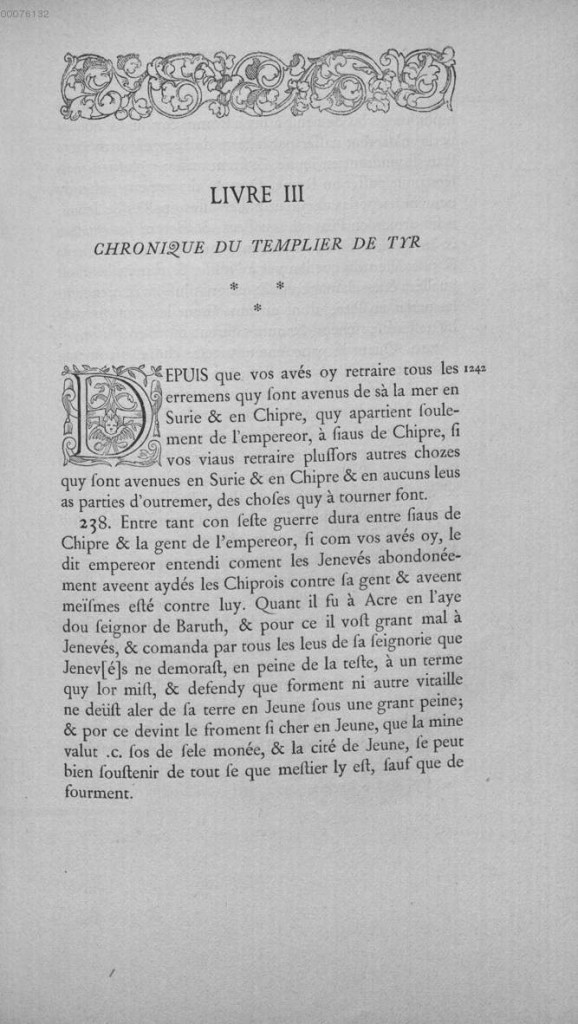
The first of the three texts of the Gestes is a collection of brief annals known as the Chronique de Terre Sainte, tracing the history of the world down to the year 1218. Since the first couple of pages are missing, it is hard to tell when the Chronique started. Internal references suggest two possibilities: either the creation of the world or the First Crusade.

The second part of the Gestes is the Estoire de la guerre des Imperiaux contre les Ibelins a highly partisan pro-Ibelin account of the so-called War of the Lombards witten by Philip of Novara

Finally, the third text is the chronicle associated with the otherwise anonymous Templar of Tyre, in which we are most interested here. The so-called Templar was – as basically all commentators since the 19th century have felt obliged to point out – not actually a Templar. For example, he was not arrested in 1308, with all other Templars of Cyprus. And while he presents a detailed account of the persecution of the Knights Templar in the following years, the events do not seem to have affected him directly and he maintains a professional distance throughout. It seems much more likely that he was a clerk or a scribe employed by the Templars, but really the only things we can say about him, we know from his own writing in his chronicle, so all the usual caveats about literary self-fictionalisation apply.

With this said, it does not seem entirely unlikely that he was born into (minor?) French-speaking nobility on Cyprus around the year 1255, served the House of Monfort based in Tyre for a significant time (c. 1269-1283), before moving to Acre and into the service of William of Beaujeu, the grand master of the Knights Templar, around 1285. The Templar of Tyre seems to have enjoyed privileged access to the grand master and also to contacts and information, e.g. the names of high-ranking spies in Cairo, capital of Mamluk Egypt. Because of this Paul Crawford speculated that the Templar of Tyre might have been some sort of „private intelligence officer“ to William of Beaujeu.
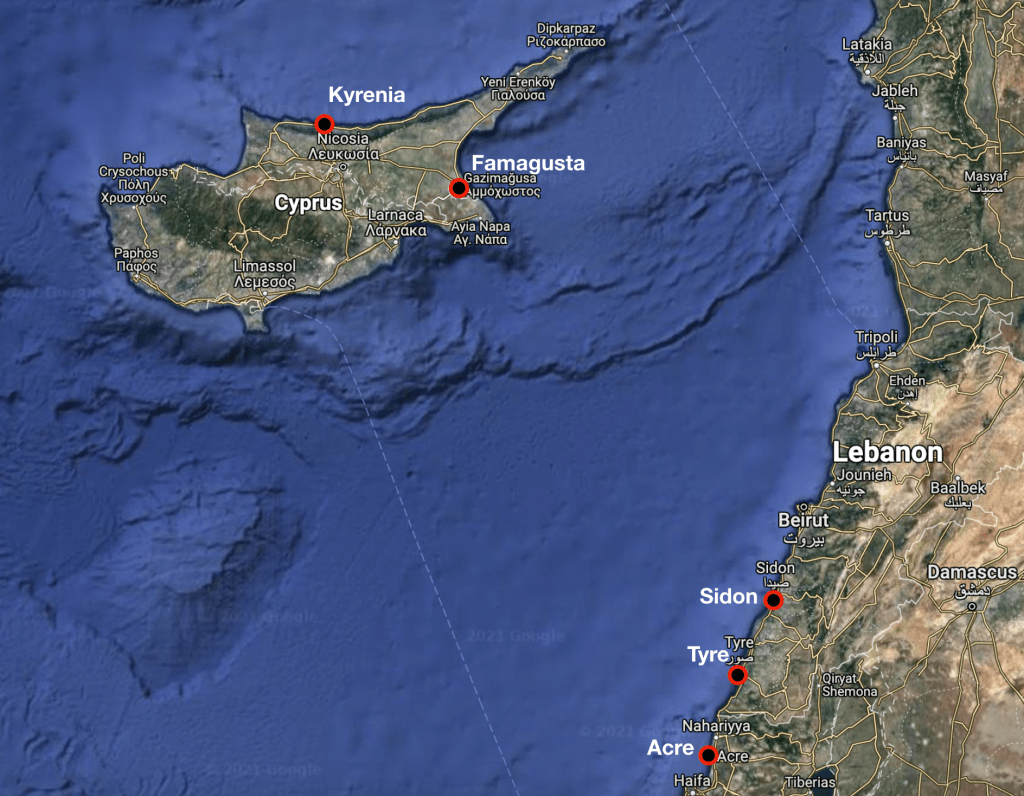
Cyprus and the Northern Syro-Palestinian littoral

The Gestes place both the grand master and his scribe at Acre in 1290 and it is generally accepted that he was indeed an eye-witness to the events leading up to the capture of Acre by the Mamluks on May 28 1291. The main reason for this is the vividness, comprehensiveness, and accuracy of his account. Since these qualities seem noticeably diminished after the death of William of Beaujeu during the defence of Acre on May 18, Crawford suggests that the Templar of Tyre was among a small group of Templars who slipped out of the city after William’s death and made it to Sidon. Indeed, the account of those final ten days, between the death of William and the fall of the last crusader hold-out in Acre, seems much less engaged and was maybe informed by second-hand accounts after the events. After Sidon the Templar of Tyre ended up in Famagusta on Cyprus, where he probably wrote the chronicle.

The chronicle does not stop after the loss of Acre, but the capture constitutes the pivotal event of its account. In the next post here, we will take a closer look at what the Templar of Tyre has to say about the fall of Acre and how this fits into the scope of CITYFALL.
Meet the Texts

This post is the first in a series which will introduce eight texts, posited at the start of CITYFALL. But before we start looking at the individual sources in greater detail, this post will offer a very brief overview of all eight, like a table of contents or a post zero if you will.

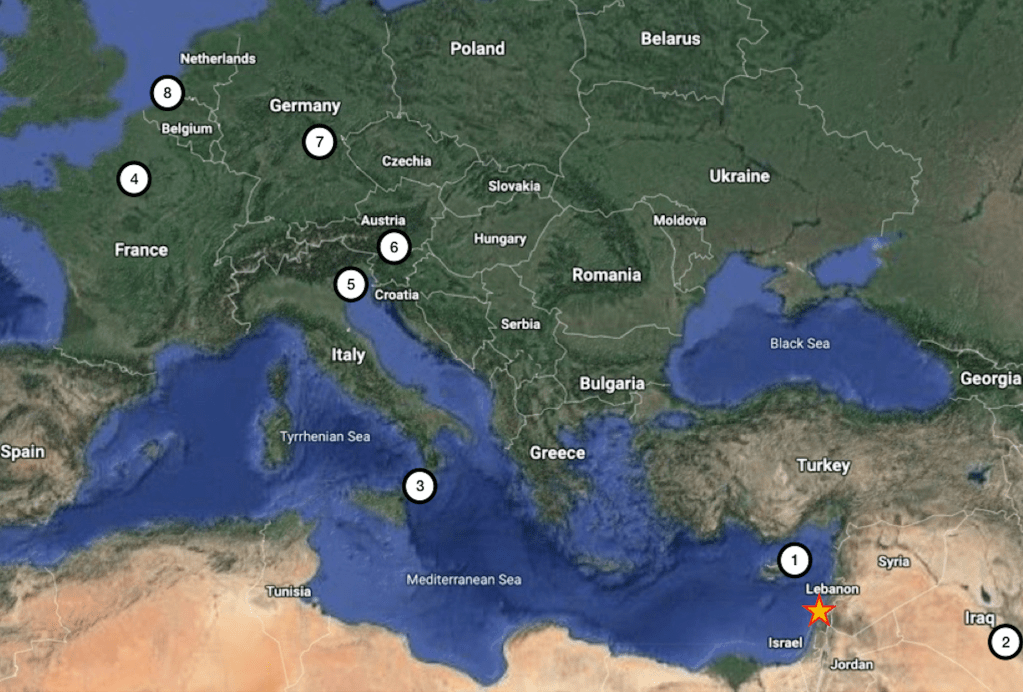
The texts come from all over the Mediterranean and from transalpine Europe and they all engage with the fall of Acre in one way or another: some at length, presenting detailed accounts of the event and developing complex lamentations and/or political programmes in order to rationalise it, aestheticise it, to render it more plausible, or to use it for political purposes. Others deal with it only in passing or within a limited clearly-defined framework, which nonetheless gives their authors the opportunity to engage with an event whose implications were debated all over the continent.

  1. Templar of Tyre, Gestes des Chiprois, between 1314 and 1321, chronicle, Cyprus, Old French.
  2. Riccoldo da Monte di Croce, Epistolae de Perditione Acconis, 1291, letters, Bagdad, Latin.
  3. Thadeus of Naples, Hystoria de desolatione et conculcatione civitatis Acconensis et tocius terre sancte, 1291, historiographical treatise, Messina, Latin.
  4. Anonymus, Excidium Aconis, 1291, historiographical treatise, Paris (?), Latin.
  5. Marino Sanudo Torsello, Secreta fidelium Crucis, 1306-1307, Venice, chronicle/crusade propaganda, Latin.
  6. Ottokar aus der Gaal, Buch von Akkon, between 1310-1320, Styria, chronicle, Middle High German.
  7. Hugo von Trimberg, Der Renner, c. 1300, Bamberg, moral-didactic treatise, Middle High German.
  8. Jacob van Maerlant, Van den lande van Oversee, before 1300, Flanders, poem/crusade propaganda, Middle Dutch.

The texts cover a wide range of genres, from letters, over poems, to moral-didactic treatises, and chronicles. Most are written in Latin, but in many European vernaculars too writers found a reason to engage with the loss of the city of Acre and the Holy Land. Some were written directly after news of the event had reached their authors, others decades later. Some were written close-by in the Eastern Mediterranean, probably by witnesses to the events or directly informed by eye-witness reports, others, however, were written in far-flung parts of Europe with no apparent connection to Acre.

Over the coming weeks, I will take a closer look at each of these texts in their respective contexts. The aim is to see how they use the city lament as a discourse form and to what effect. Where are similarities and – almost more interestingly – where are differences? How are texts and lamentations embedded in their contexts? Do texts, which originate in the European-Christian networks of the Mediterranean, choose to focus on different aspects than those written further afield from the events, at the courts and in the cities of transalpine Europe? What do they do to appeal to their audiences? Why do they lament Acre in the first place? Where and how do they assign blame? How to they communicate concern, grief, and – yes, let’s go there – collective trauma in the face of the overwhelming impact of historical occurrence? What remedies do they propose? What reactions? What does the impact of a now past event mean for these texts conceptualisation of the future? Another line of enquiry, which would lead away a bit from the research goal of this project, but seems necessary to get a complete picture, is to see if there were other ways to respond to the event than outpourings of grief and lamentation.

The above list is of course not exhaustive and serves mostly as a starting point for further enquiry. So I expects it to grow significantly over the next couple of months. If you know of any relevant texts or if you have come across any other texts from up to the 1340s/50s, in which the lament for a city – any city! – features, I would be most grateful if you could point me in the right direction.

Lamenting Acre

When the glorious city of Acre thus fell, all the Eastern people sung of its fall in hymns of lamentation, such as they are wont to sing over the tombs of their dead, bewailing the beauty, the grandeur, and the glory of Acre even to this day. Since that day all Christian women, whether gentle or simple, who dwell among the eastern shore (of the Mediterranean) dress in black garments of mourning and woe for the lost grandeur of Acre, even to this day.

Ludolf von Sudheim, De itinere Terrae Sanctae (1336-1341), translated by Elka Weber in: Traveling through Text, Message and Method in Late Medieval Pilgrimage Accounts, New York/London 2005, p. 126.

In the eyes of the German traveller Ludolf von Sudheim, who visited the Levant in the 1330s, so several decades after the loss of the military control of the Holy Land for the European Christians, the lament for Acre seemed rather strange. He singles it out as something peculiar to the custom of the peoples inhabiting the Eastern Mediterranean. A generous reader would think him bemused by displays of cultural practice foreign to him, a less generous reader would read it as an expression of western condescension. Either way, the „othering“ of the city lament for Acre happening here serves as an apt starting point for CITYFALL. At its heart the project strives to assess the cultural value of the city lament across Europe in the later Middle Ages, the very form of discourse which Ludolf presents here as something foreign and connected to other parts and peoples.

This seems all the more remarkable considering how, when in 1291 the Egyptian Mamluks conquered Acre – at the time the last outpost of the Christian crusaders on the Eastern Mediterranean littoral – the event caused an outcry throughout the christendom. The pope called for a new crusade to reclaim the city, which had been the most important gateway for European pilgrims and crusaders to the sites of the Holy Land, since the permanent loss of Jerusalem in 1244. The Dominican missionary Riccoldo da Monte di Croce, who was in Bagdad, when word of the fall of Acre reached him, exclaimed in one of his letters ad ecclesiam triumphantem:

“Where is Acre, where are the Christian churches which were there? Where are the relics of the saints, where are the men and women religious who praised the Lord just like morning stars?”

Riccoldo da Montecroce, Epistolae ad ecclesiam triumphantem, Letter IV , translated by Rita George-Tvrtkovic in, A Christian Pilgrim in Medieval Iraq, Riccoldo da Montecroce’s Encounter with Islam, Turnhout 2012, pp. 167–168.
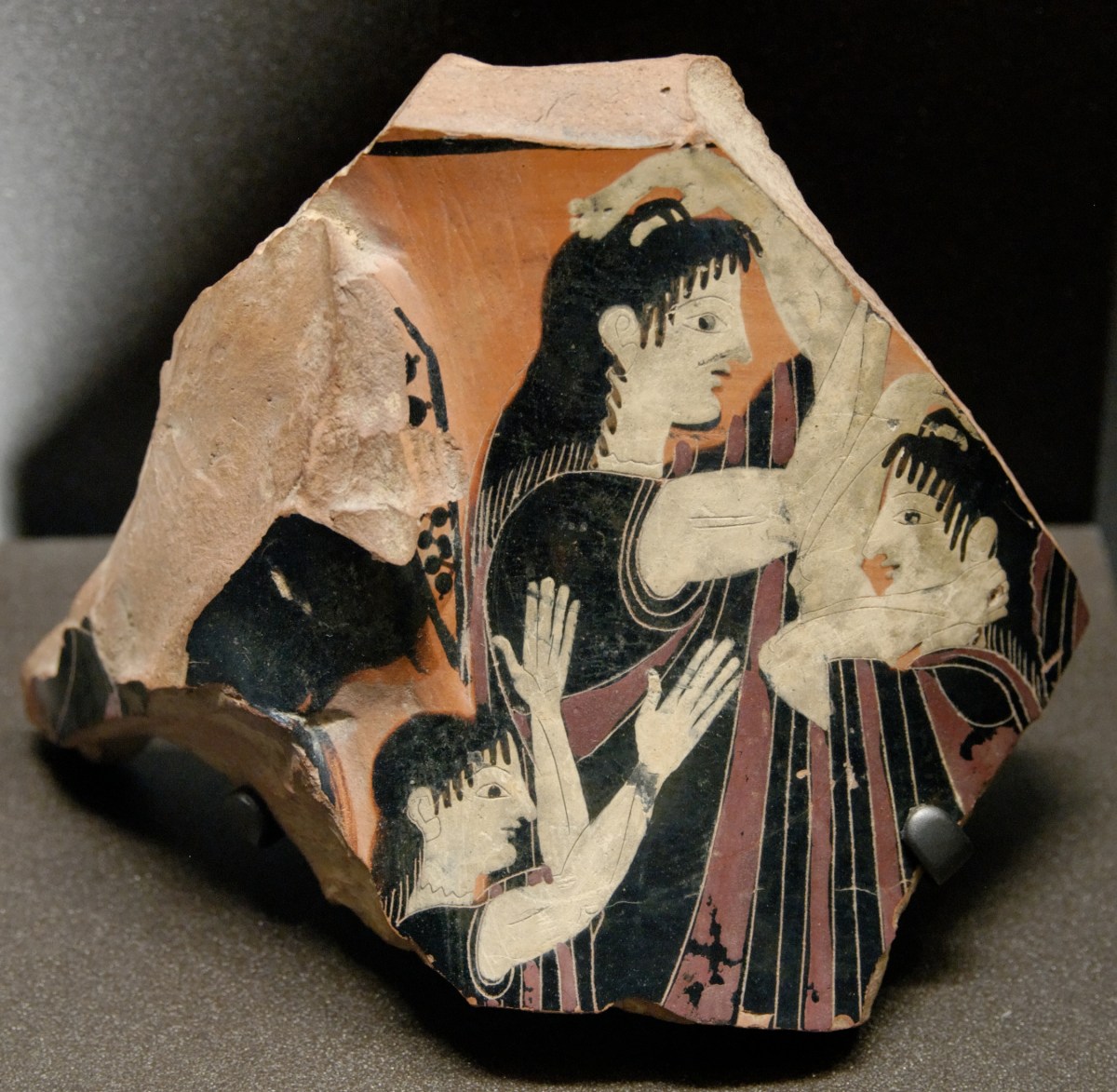
Female mourners, Fragment of an Attic black-figure loutrophoros, Attica, Greece, 6th century BCE

Like Riccoldo many other authors and commentators of the time struggled to make sense of the event. In order to rationalise the events they resorted to the discursive techniques of lamenting – like Riccoldo uses the well-established ubi sunt trope – which go back to biblical and ancient traditions. Their attempts were aimed at reconciling historical occurrence with their audiences axiomatic expectations centred around a world ordered according to God’s divine plan in which the Christians could not and should not fail.

Closer to Ludolf’s native lands (he was born in Osnabrück and served as a priest in Sudheim, Westphalia), German-speaking writers joined the lamentation. Ottokar aus der Gaal, am author from a knightly family from Styria of all places, wrote a comprehensive depiction of the fall of Acre, as a part of his monumental Styrian Rhyme Chronicle in the early decades of the 14th century. This is, remarkably, the only German vernacular text entirely dedicated to a specific and clearly identifiable military action throughout the entirety of the crusades. Ottokar too employs rhetorical strategies drawn from the discourse type of the lament like exclamations, drastic depictions of the destruction, calls for collective lament, accusations and assignment of blame, contrasting motifs (then-now, here-there), and quarrelling with God.

The Hospitalier Master Mathieu de Clermont defending the walls of Acre in 1291, Oil painting by Dominique Papety, 1845, Versailles

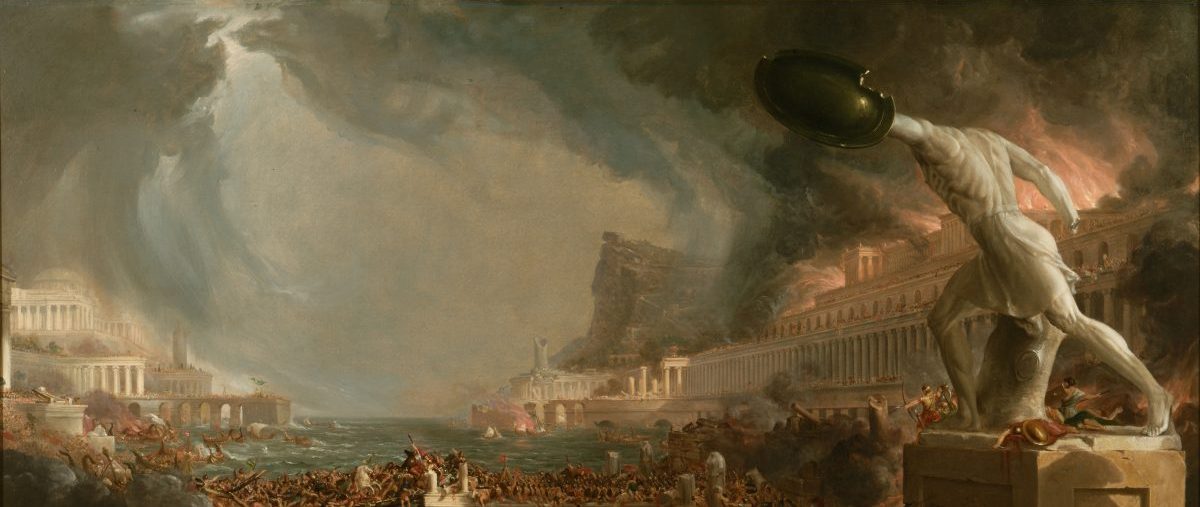
Similarly, Hugo von Trimberg, who in his early fourteenth-century moral-didactic text Der Renner comments on the fall of Acre, provides a list of cities, which – just like Acre – have fallen before, due to, he claims, the wickedness and moral corruption of their inhabitants. From the biblical cities of Sodom, Gomorrha and Jerusalem, Hugo moves on to the ancient cities of Troy and Carthage, touches on Rome, and finally arrives at Acre, in his own time.

Closer to the event, the otherwise unknown Magister Thadeus of Naples, based in Messina at the time, writes a short chronical treatise, entirely dedicated to the conquest of the city by the Mamluks, in which he frames the fall of Acre as the fulfilment of biblical prophecy in its most apocalyptic colours:

[] through which the wrath of God did not delay in coming down upon them just as the ancient annals of the sacred scriptures relate it came down from heaven full of sulphurous fire upon Pentapolis, from outside, moreover, with a devastating sword, and with terror reigning inwardly; and at the last, with the precious spoils in which that city was until then so rich having first been looted from their precincts, the deadly enemies and infidels, generally exposing it to ruin and fire on every side, made it, in hatred and contempt of Christ and his most holy name, like a heap of piled up rubble, and left it, alas, desolate, without any inhabitant.

Thadeus of Napels, Ystoria de Desolatione et Conculcatione Civitatis Aconensis et Tocius Terre Sancte, ll. 752-761 (If you think the translation is choppy, have a look at the Latin)

The reference to Pentapolis (a group of five Biblical cities – Sodom, Gomorrha, Segor/Zoar, Adama, Seboim – situated in the lower Jordan valley [Gen 13-14, Wis 10:6] ) puts the fall of Acre alongside the Biblical destruction of Sodom and Gomorrha [Gen 19]. Thadeus frames a military defeat as an act of divine retribution against his sinful people. This is part of the peccatis nostris exigentibus discourse, an easily-available and often-used template to make plausible collective experiences of loss, defeat, or humiliation: devastating though as the event might seem, the retributive logic of the argument goes, it is still part of God’s plan and has its place in His divine ordering system of the world. It is His people that have failed and must be punished and pushed back onto the righteous path. This reasoning makes it possible to rationalise historical occurrence, which stands counter to the autocentric expectations towards the progress of history of a Christian medieval audience, as a darkly pedagogical intervention by God, without casting doubt on the premises and axioms which underpin the world-view of these audiences.

The peccatis nostris exigentibus discourse rose to prominence in the middle of the twelfth century, used by none other than Bernard of Clairvaux and Otto of Freising so explain the humiliating defeat of the so-called Second Crusade. It remained a useful explanatory model for defeat throughout the Middle Ages and later, so its actualisation after the loss of Acre comes as no surprise.

Bernard of Clairvaux preaches the crusade at Vézelay, Oil painting by Émile Signol 1804-1892.
After the failure of the Second Crusade Bernard had some ’splainin‘ to do.

This should suffice to give a first impression of the varied and expressive forms of lament the fall of Acre triggered across Europe in the later 13th century. More texts both Latin and from various European vernaculars – Old French, Middle Dutch, Middle High German – will be presented here in the coming posts.

Ludolf was probably mostly moved by displays of performative (and female!) lament when he expressed his alienation. However, it has become clear that the negotiation of the loss of Acre through textual discourse was very much at home in his native lands. It was indeed a central concern of the time shared between many writers in mediterranean and transalpine Europe.

With this short introduction of my research subject I am going to leave you for now. I have many ideas about what to do next and I am looking forward to publishing posts here of a series, in which I will present to you my most important source-texts (provisionally named „Meet the texts”), and of another series, in which I will provide you with background information on key concepts, events and people (What is a lament to begin with? What’s so special about Acre? What about the crusades though? Who was this Riccoldo fellow? Why in Styria of all places?). I also plan on posts about books and articles I read (possible series titles: „Fresh from the research shelf“? „Shelf life“?) and the occasional notice about papers, publications, and presentations coming up. So, watch this space.

The madness of the research shelf

Welcome to CITYFALL!

Mother Ningal, like an enemy, stands outside her city. The woman laments bitterly over her devastated house. Over her devastated shrine Ur, the princess bitterly declares: “[..] Alas, my city has indeed been destroyed before me []. Outside the city, the outer city was destroyed before me – I shall cry ‘Alas, my city.’ Inside the city, the inner city was destroyed before me – I shall cry ‘Alas, my city.’

Lament for Ur, 7. Kirugu, c. 2000 BCE

This is the blog of the Horizon 2020-funded Marie Skłodowska-Curie Research Project CITYFALL. The project is based at the Institute of Classical Philology at the University of Bern where it is closely aligned with the SNF-funded project Lege Josephum! Professor Gerlinde Huber-Rebenich is both the principal investigator of that project and the institutional supervisor of CITYFALL.

Both the blog and the project are run by me – Christoph Pretzer.

In this blog you can expect insights into the various aspects of the research involved with the project, like the sources at the heart of CITYFALL, the epistemological problems I encounter on the way and the theoretical tools I employ to (hopefully) solve these problems. It will also include funny, noteworthy, or simply bizarre observations made along the way, self-indulgent pop-culture references, unabashed medievalist geekery, and reliably tenuous connections to present-day issues and events.

I am aiming for fortnightly posts but in practice this will probably mean a torrent of early posts, which will then settle into a more comfortable semi-regular rhythm, to then infallibly peter out as the actual project work proceeds.

This blog is also hopefully not going to be a one-way-street but rather a welcome space for me to interact with a wider readership, both academic and non-institutionalised, so please feel free to e-mail me, use the contact form of this blog, or flock to the comment section. I am here.

About the project

The project examines the lament for the Levantine city of Acre, which was conquered by the Mamluks in 1291. Of particular interest is how the medieval lamentation for the loss of Acre across various texts written from the late 13th until the mid-14th-century – both Latin and vernacular – ties into ancient and biblical traditions.

The objective of CITYFALL is to understand how medieval authors used biblical and ancient traditions lamenting the falls of cities in their own texts to create the political and cultural identities of the high and later Middle Ages and to negotiate current events by contextualising them in these ancient and biblical traditions. This objective is achieved by pursuing the main research aims:

Aim 1: to track the process of transformation, in which traditions negotiating collective trauma and cultural loss are reshaped into political narratives which could serve as foundational myths for medieval European polities like the German Empire.

Aim 2: to show how medieval authors lamenting fallen cities in medieval texts claim their heritage and make their historical prestige and authority available for the communities they are writing for. With this, new identities can be constructed and contemporary concerns of political and cultural belonging can be negotiated.

Aim 3: to gain a better understanding how medieval authors responded to their audiences need for guidance in the face of historical occurrence they could not bring in line with the cultural axioms of their worldview and how biblical and ancient narrative models helped to reconcile the expectations shaped by these axioms with their evident suspension by historical occurrence.

The goal for of CITYFALL beyond the research objective is to contribute to a growing understanding how medieval Europe was part of a greater East-West continuum of political and cultural imagination, which rested on a shared pool of narratives and discursive techniques.