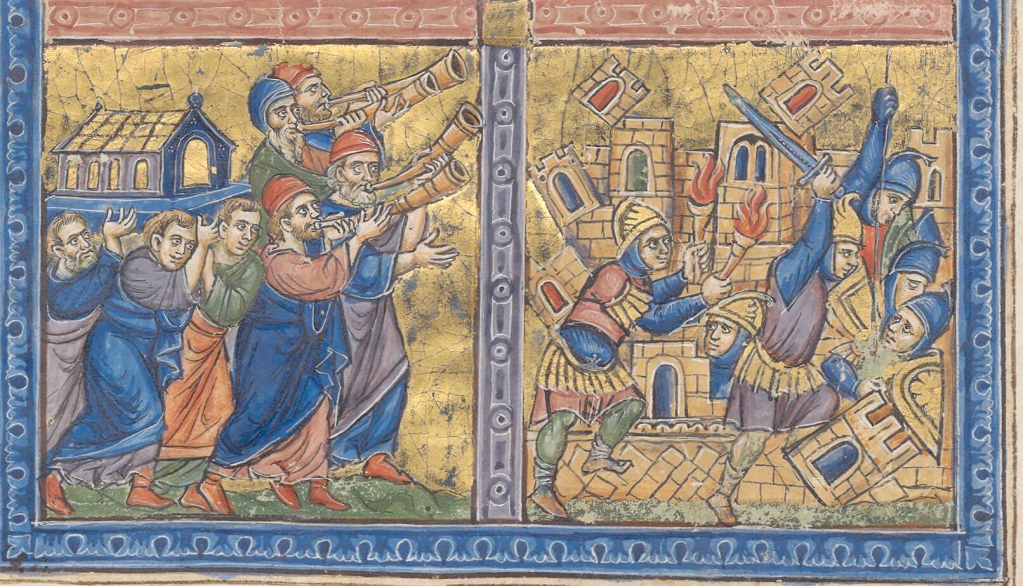
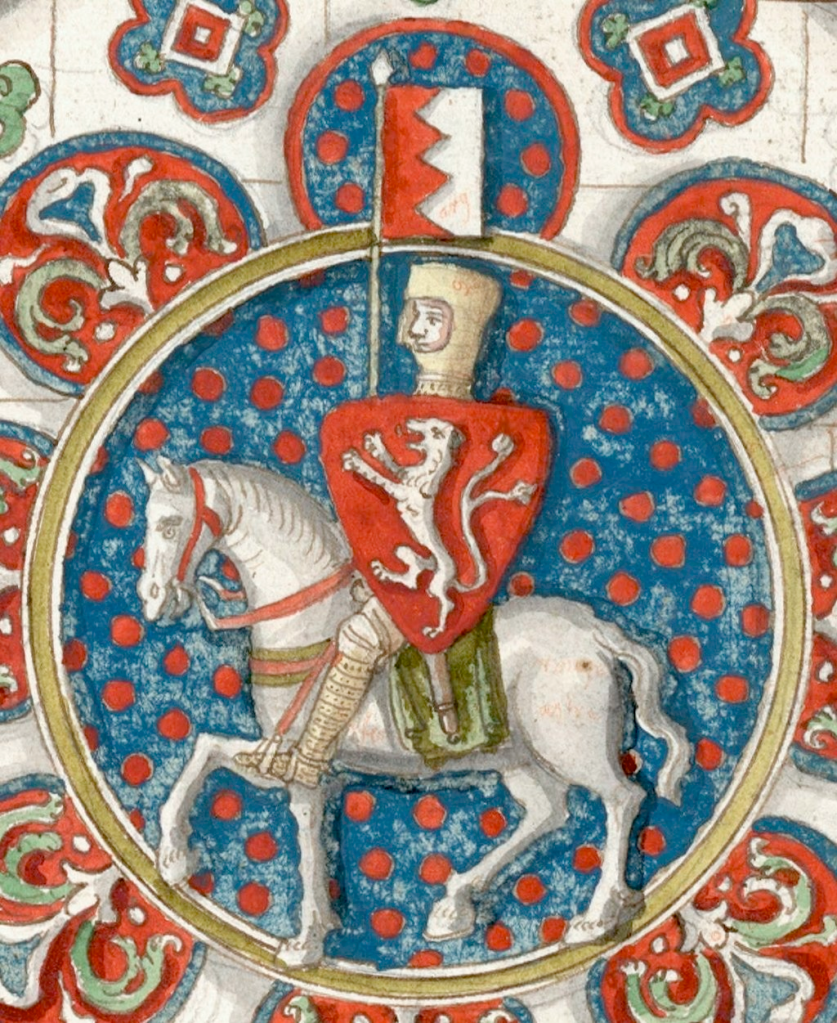
Bible française abrégée, XIIIe siècle [Bible de Saint-Jean d’Acre], 1250-1254, Bibliothèque de l’Arsenal, Ms-5211 réserve, fol. 69v.
The Chair for Medieval and Early Modern History of Europe at TU Chemnitz is inviting paper proposals from across all disciplines of Medieval and Early Modern Studies engaging with all aspects of “Warfare and the Belliphonic”.As an intense sensory experience, pre-modern war was understood and reflected by contemporary observers as an acoustic event. Thus, in order to understand how wars were planned, waged, perceived, and portrayed, is has been established as a productive novel approach to ‘listen’ to medieval warfare: the sounds of weapons, screams, speeches, music, and signals, which created and structured social spaces and narrations organised around war and warfare. These sounds are what is studied under the term ‘the belliphonic’.For this session we are particularly interested in papers exploring the weaponisation and utilisation of sound and its perception for the purposes of warfare. Proposed papers might examine, but are not limited to, the following topics:
Sonic warfare.
Sound and noise as psychological warfare.
Pragmatic sounds as a means of communication like commands and signals.
Hearing (and not hearing) as analytical tool in warfare.
The purposeful suppression of sound as a tactic.
All other aspects of the belliphonic.
We will be organising one or more session(s) addressing these topics. If interested please send abstracts of no more than 300 words plus your contact details, academic status and institutional affiliation to
Only recently have I come across a fascinating local/regional Swiss connection to the capture of Acre in 1291, which I want to explore a bit more closely here.
I found out that there is an antepedium, i.e. a liturgical cloth used to cover an altar, at the Historical Museum of Bern (!), with French, Greek, and Latin text on it, which was probably made in Cyprus and arrived in Switzerland c. in 1291!
Why is this exciting (not that a tri-lingual Cyprian antependium is not exciting in and of itself)? Because the guy who brought it here was no other than Otto de Grandson.
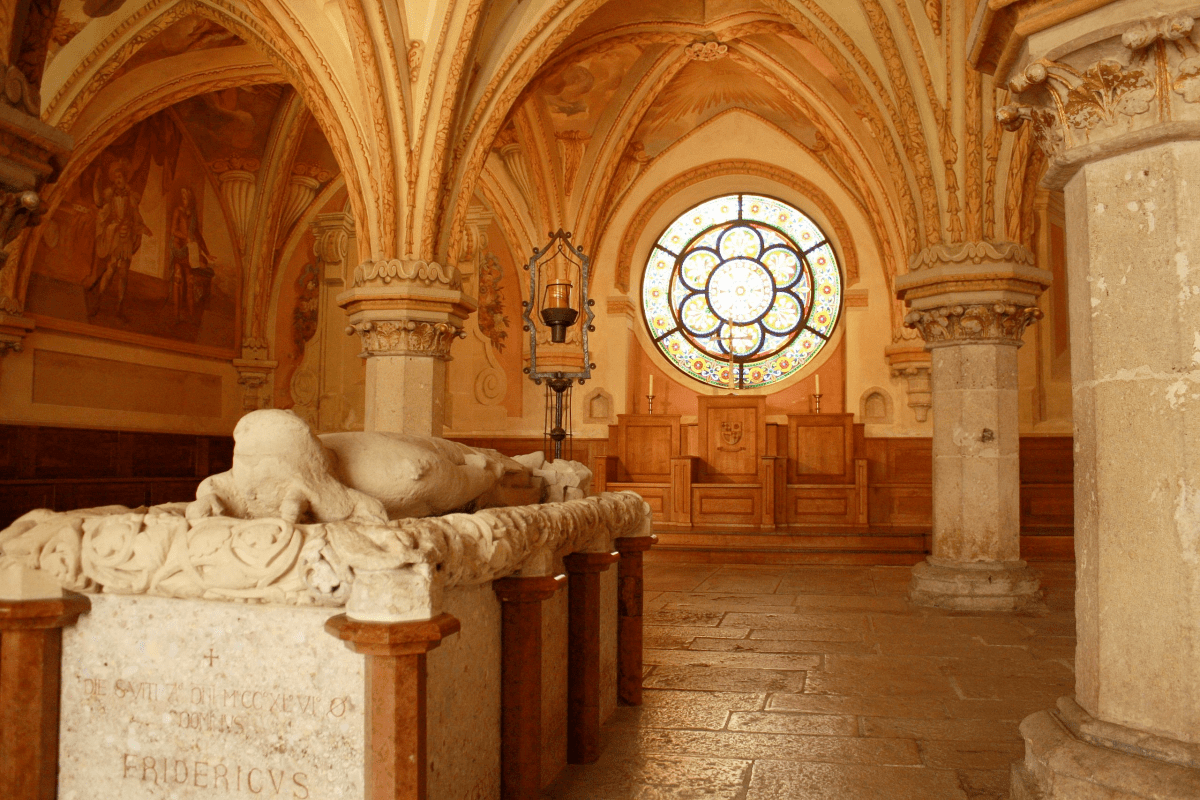
Whose grandson? Well, Otto de Grandson was a knight from Grandson, in what is now northwestern Switzerland, who fought at Acre in 1291 in the service of the English king and commanded the English contingent there. He is buried in the Lausanne Cathedral (which is about 100 kms to the West of Bern).
A mesh of exciting connections began to unrol: a „Swiss“ knight, who fought in Acre and upon his return brought an artefact from the East, which was now in a museum just 10 mins away from where I work. Moreover, this knight was buried in a spectacular sculptural tomb not too far away either.
So, who was this guy, and how are he and his antependium connected to Acre and Switzerland?
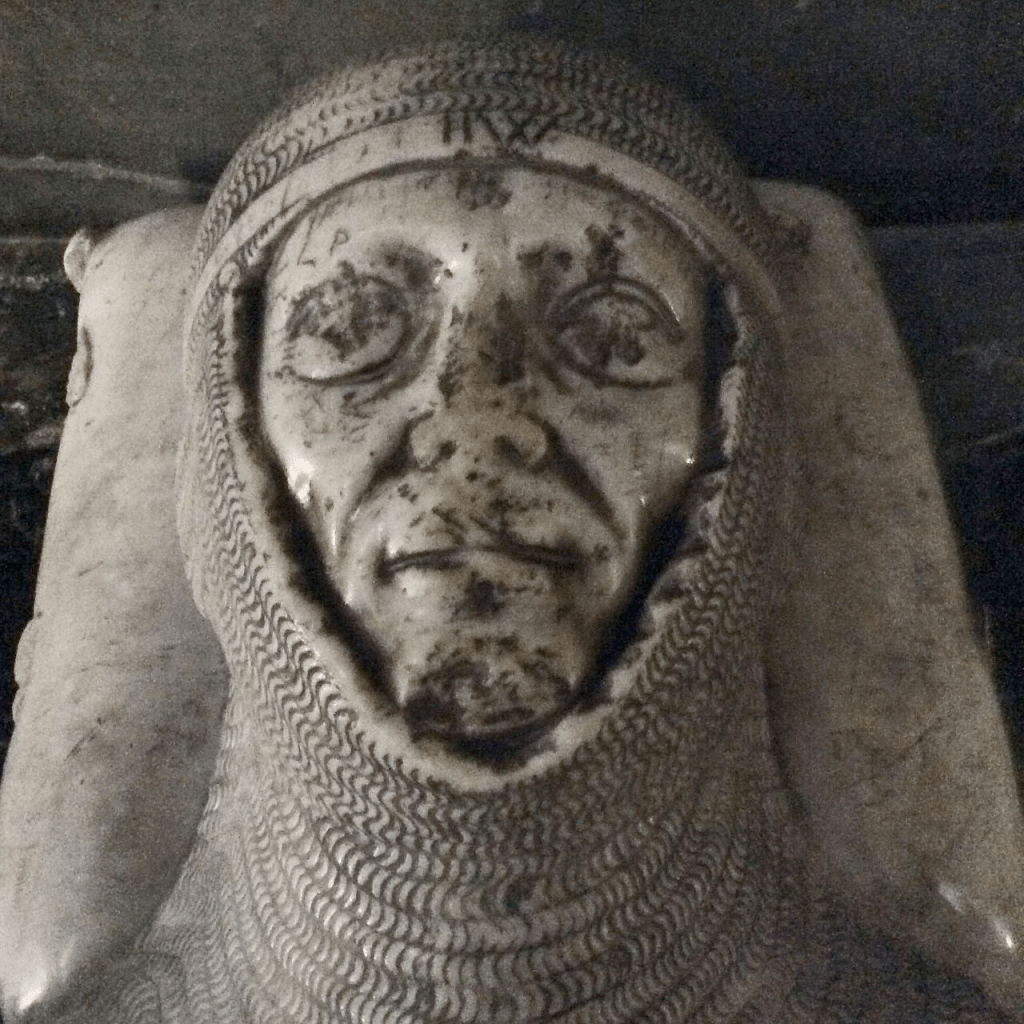
Face detail of the marble effigy on Otto’s tomb in Lausanne cathedral
Otto de Grandson (of whose name a great variety of spellings abound, among them: Othon, Oton, Othes resp. Grandison) was born in c. 1238 as the oldest son of Pierre de Grandson, lord of Grandson. He lived a long and illustrous life of diplomatic service, knightly pursuits, crusading, and castle-building, well worth of a novel or indeed a series of novels. The stations of his life connect his tiny corner of modern-day Switzerland to England, in particular the royal court at London, and parts of Wales, to the French royal court at Paris, to Gascony and to Flanders, to Italy, the Roman Curia in Rome and Orvieto, also to Sicily, and, finally to Cyprus, Armenia, and, well Acre and the Holy land.
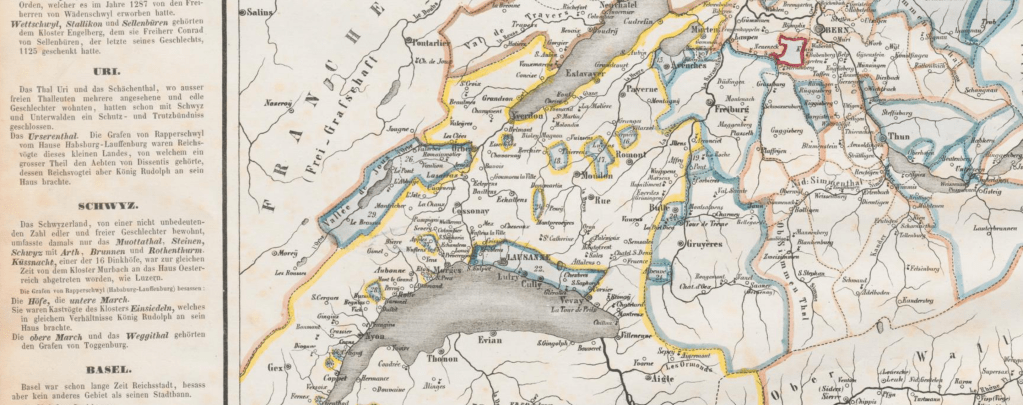
But his long and eventful life started where it would also come to a conclusion, when he died probably well in his 80s in 1338: in Grandson, a small fief with an impressive castle about 25 kms north of Lausanne, on the southwesternmost tip of Lake Neuchâtel. In the 10th and 11th century Grandson, situated in the very northwest of modern-day Switzerland, had been part of the Kingdom of Burgundy. Around 1300, it was part of the Barony of Vaud, which was in turn a semi-independent part of the County of Savoy. Savoy was a small but influential polity, with its centre in northwestern Italy. But because it controlled the western alpine passes, which connected the ancient, cosmopolitian, and rich Mediterranean world to the increasingly commercialised and prosperous world of Northwestern Europe, the counts of Savoy were politically and economically punching way above their weight. In 1313 count Amadeus V achieved the status of imperial immediacy („Reichsunmittelbarkeit“) from Emperor Henry VII.
The western part of what is now Switzerland c. 1300
Otto became to be the most prominent of the so-called Savoyard knights, a group of knights from Savoy, who, in the 13th and early 14th century, went to serve the king of England (the topic of the Savoyards in 13th-century England is an endlessly fascinating one, and you can read a more comprehensive and highly informative piece by Christopher Tyerman about it here).
Some background on the English-Savoyard connection: in 1236 King Henry III of England had married Eleanor of Provence, who had strong family ties to the counts of Savoy. When she moved to London, she brought with her a large Queen’s party of uncles and cousins, know as the „Savoyards“, who were given influential positions at the English court. Oredictably, this earned them the enmity of the Londoners and the English barons. Most prominent among the Savoyards was Eleanor’s uncle William of Savoy, Bishop of Valence, who would become one of the closest advisors of her husband, the English king.
This marked the beginning of a close relationship between the English monarchy and the County of Savoy. The young son of the lord of Grandon, Otto, would make is way to England, in order to serve King Henry III in the 1250s. At the time he would have been between 14 and 18 years old. It is likely that he served in the royal household of Henry’s son and heir Prince Edward (later King Edward I aka „Longshanks“, Hammer of the Scots, of dubious Braveheart fame) during the battles of Lewes (1264) and Evesham (1265) of the Second Barons‘ War against the English barons led by Simon de Montfort. After the death of Simon and the decisive defeat of the barons at Evesham, Otto was awarded by Prince Edward with properties close to London .
Simon of Montfort, 6th Earl of Leicester, and, for a time, de facto ruler of England, as depicted in a stained glass window in Chartres Cathedral
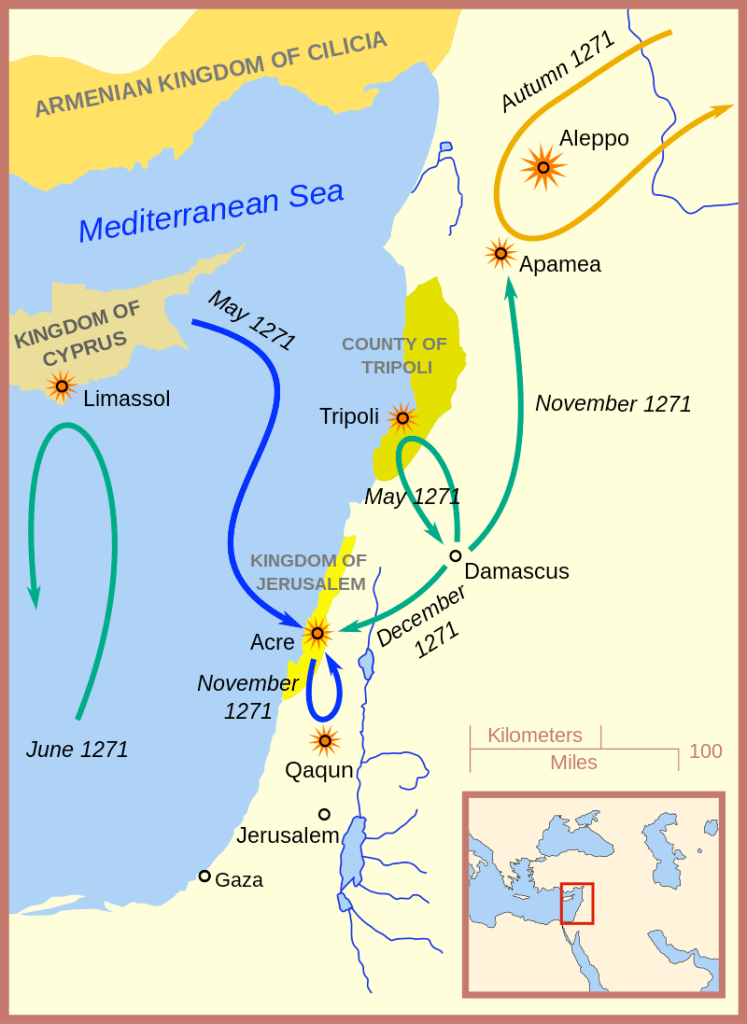
In 1271, after Otto had been knighted together with prince Edward, he joined Edward on his crusade to the Holy land (an endeavour sometimes termed the 9th crusade). It can also, maybe more sensibly, be seen as a delayed part of the 1270-crusade of the French King Louis IX, who had landed in Tunis with his army, only to die there from disease shortly after his arrival. When Edward and Otto arrived in Tunis much-delayed to join the French king, he was already dead, and the treaty that had been signed between the crusaders and the Muslims, obliged the Christian lords to not attack Tunis anymore. After withdrawing to Sicily and considering their next steps for some time, Edward and his crusaders sailed East, were they arrived in Acre on 9 May 1271 with eight sailing ships and a thirty galleys.
It can be assumed that Otto took part in most of the (limited) military action that followed: raids and skirmishes with Bairbars‚ Mamluks, which were at the time harassing what remained of the Crusader states on the Eastern Mediterranean littoral. In the end the fighting did not amount to much, except maybe to keep the Mamluks away from Acre. At least for the time being. But regarding Otto there is one particularly striking episode from that time, transmitted by the Flemish chronicler John of Ypres, who wrote his Chronicon not long after Otto’s death in 1338:
„I have heard the following story from the lips of certain honourable and trustworthy men of Savoy, who, however, told me not of what they had seen but of what they had heard. Now these men alleged that once upon a time there was in Savoy a certain lord of Grandson, whose wife bore him a son. When the astronomers were summoned to examine, calculate, and decide the child’s nativity, they declared that if he grew to manhood, he would be great, powerful, and victorious. There was also present on this occasion a person full of superstition, or shall I rather say of divine inspiration, who taking a brand from the hearth declared that the boy would live only so long as the brand lasted, and that he might live the longer thereupon had the brand built up in a wall. The boy lived, grew to manhood, and to old age, with ever increasing honour; until at last, weary of life through burden of his years, he ordered the brand to be taken out of the wall and cast into the fire. Hardly was the brand consumed, ere the good knight expired. My informants told me further that this fateful lord of Grandson was beyond sea in the company of the son of the King of England; and that when he heard how the prince had been poisoned, alone, trusting, as I suppose, in the fate that had been foretold for him, dared to suck the venom from the wound; and thus through his aid was Edward healed. Afterwards this lord of Grandson and his kinsfolk rose to high with the Kings of England, and unto this day have great repute in that country. But of this can I avouch more than was told to me.“ (trans. by Girart Dorens 1909)
An almost fairy-tale-styled literary image emerges of Otto Grandson as a man whose life was pre-ordained by prophecy and vouchsafed by miraculous circumstances. A man who, thanks to these circumstances, was able to control the conditions of his own life, and even determine the hour of his own death, a awe-inspiring and also slightly unnerving quality to medieval readers.
Almost twenty years later, after many more years of distinguished service for Edward, now King of England, Otto would return to the Holy land to play an important part in the final battle for Acre in 1291. I am going to explore this in a second post soon, so watch this space.
Organiser: MSCA CITYFALL, Institute of Classical Philology, University of Bern, Switzerland
As a military, religious, geographical, and socio-culturalphenomenon the crusades were, from the beginning, closely linked to cities. Jerusalem with its loca sancta became the goal, both as a physical place and as a metaphysical concept. Ancient cities like Antioch, Tripoli, or Edessa became the centres of, however short-lived, crusading polities. Ancient ports like Tyre or Acre became maritime hubs as well as battlegrounds between East and West. Cities ruled by various Muslim power groups like Damascus, Bagdad, Konya, or Cairo figured at times as either allies or enemies to the crusader states. Often the impact of the crusades on those cities pushed them into various states of crisis: they were besieged, destroyed, conquered, sacked, depleted of their populations, razed, occupied, plundered, rebuilt, reorganised. This did not only affect cities in the Eastern Mediterranean and the Middle East, but also, to varying degrees, cities across Europe: the cities on the Rhine were affected by atrocities against their Jewish communities, crusading movements affected cities like Lisbon and Toledo, Toulouse and Athens, Zara and Constantinople. Equally the crises affecting these cities were not exclusively of military nature: usually the upheaval was just as much of economic, demographic, and religious nature. And in the realm of literature and art too, cities were plunged into crisis by the crusades; be it by the chivalrous struggle for Antioch and Jerusalem in the Old French Cycle de la croisade, through the depiction or burning and destroyed Levantine cities in German prose chronicles from the later Middle Ages, or through the lamentation for the lost cities of Al-Andalus in the Arabic Ritha‘ al-Andalus by the Sevillian author Abu al-Baqa ar-Rundi.
We invite scholars at all career stages to submit proposals for twenty-minute papers examining how cities in the context of the crusades were affected by crisis. Potential speakers are invited to understand all three terms in the broadest possible terms and to explore wide-ranging diachronic and synchronic links across time and space, drawing on a variety of sources, like narrative texts, including literature, archival and documentary sources, or archeological, epigraphical, art-historical, and other material evidence.
Please send paper proposals of no more than 300 words in English, accompanied by a short CV including affiliation, position, and contact details by September 28 2023 to Christoph Pretzer: christoph.pretzer@unibe.ch
This project has received funding from the European Union’s Horizon 2020 research and innovation programme under the Marie Sklodowska-Curie grant agreement No 101028770.
I have been very bad about keeping up this blog for the last… year or so. What I predicted at the opening happened and the actual work, which usually is not very blog-o-genic, kicked in. Apologies to all four of my readers! I thought I’d get back into the habit of writing here, by presenting a shiny, new, and very interesting text, I recently happened upon, which fits in very well alongside my other texts.
Historia Sicula: text and context
This new text is the Histora Sicula written in Medieval Latin by the Sicilian lawyer Bartolomeo da Neocastro. It covers the history of the Kingdom of Sicily between 1250 and 1293 and is regarded as one of the best sources for the history of Sicily and Southern Italy in the second half of the 13th century, in particular for the so-called Sicilian Vespers. It is relevant for the purposes of this project, because it also contains a passage on the loss of Acre, but more about this later.
Few details are known about the author: the Calabrian commune Nicastro now part of the city of Lamezia Terme has been identified as the likely Neocastro from where the Historia’s author Bartolomeo hailed. He seems to have been a lawyer, active mostly as a judge in Messina, and later also one of the four councils elected to assist the new mayor of Messina, after the dust of the Sicilian Vespers had settled. This is the extend of what can be gleaned from the historical record.
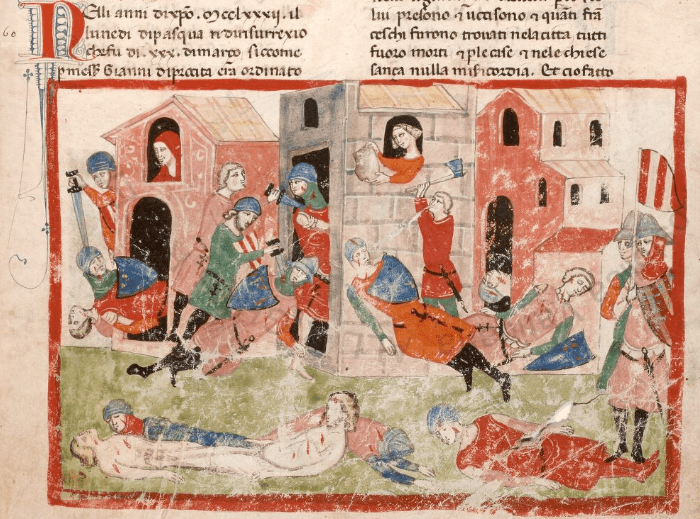
The Sicilian rebellion against King Charles, Nuova Cronica § 61. 14th century
From his writing it is clear that he was highly educated, not just in law, but also in literature: e.g. in the prooemium of his chronicle, he claims to have written his Historia in two versions, the first one in metrico stylo, probably in dactylic hexameters, and the second one in prose. He did so in response to his son asking for a more accessible version of the chronicle. Of these two only the prose version survives, but this one too is filled with references to Vergil, Lucan, and other authors of classical Latinity. Scholarship has also made it plausible that Bartolomeo was involved in several translations from classical Greek, in particular of the works of Aristotle, for King Manfred of Sicily.
Bartolomeo begins his chronicle with a clear mission statement: to tell Siculorum gesta […] contra Gallos (Remind you of anyone?). The conflict between the Sicilians and the French, in Bartolomeo’s account a conflict between between freedom-loving (Sicilian) rebels and their tyrannical (Anjou/French) oppressors, forms the backbone of his chronicle. It is addressed to the sons of Emperor Frederick II – mainly Konrad and of course Manfred. This historical narrative opens with Frederick’s, the origo […] operis huius, death at the Castell Fiorentino in Capitanata in 1250. It is depicted as the peaceful and dignified passing of an ideal and illustrious king. His mortal remains were then carefully transferred to Palermo, the burial site of his royal and imperial ancestors. After this the Historia focusses mainly on the struggles of the Hohenstaufen in Southern Italy and Sicily and later on the Sicilian Vespers. But toward the end chapter 12o stands out, and it is this chapter that makes the chronicle so topical for this project.
Themes and comparison to the Book of Acre
Chapter 120 frames news of the fall of Acre arriving at the papal court of Nicholas IV as a kind of „Botenbericht“: a Greek monk of the order of St Basil, called Arsenius, is presented to the pope and tells him what happened at Acre: „From a bitter heart, oh Holy Father, I will tell you about the most wretched event at Acre, if this pain has not already spread to your ears.“ In the monk’s now following account several interesting points stand out, which – interestingly and maybe surprisingly- show the most similarities to Ottokar’s aus der Gaal Middle High German version of the events in his Book of Acre.
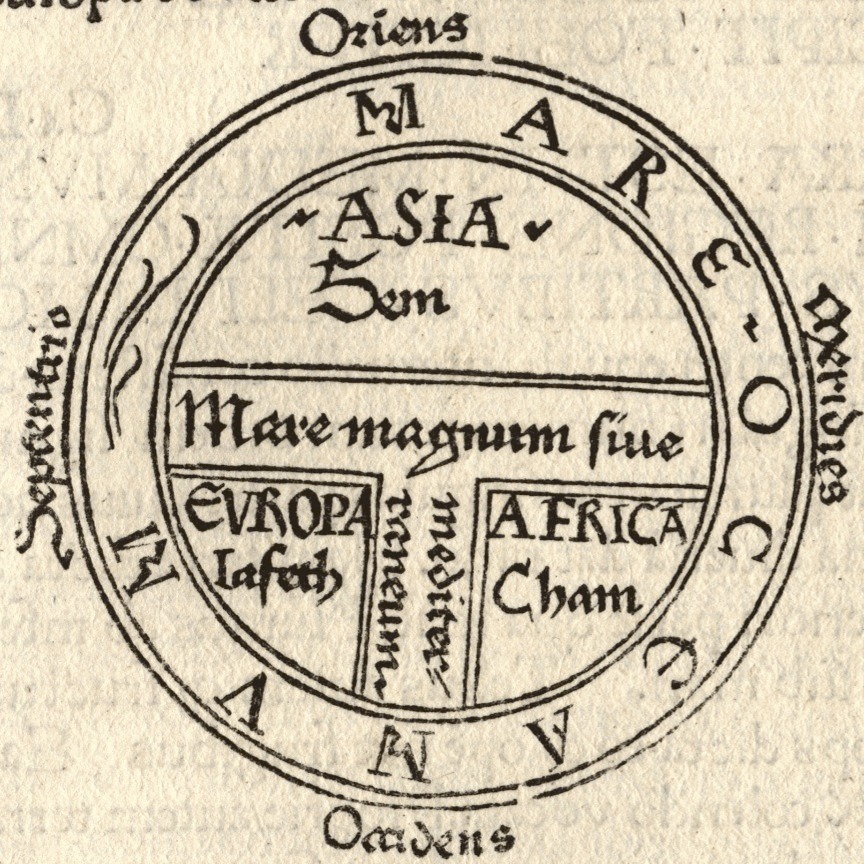
Arsenius begins to describe the seemingly infinite size of the army amassed by the enemies in front of the city to conquer Acre: „There came together the numberless peoples of Damascus, of the Parthians, and an uncountable mass of Arabs. India, Libya, and all parts of the world, which were beholden to the realm of Babylon, sent their troops there.“ This is of course topical for the depiction of „heathen“ armies in medieval Christian narratives: their size spans the size of the world. From all ends of the globe the heathens come together to wage war on the Christians. Facing an endless sea of enemies has several advantages for the Christians: it builds on the Old testament-tradition [Gen. 10: Hae sunt generationes filiorum Noe, Sem, Cham et Japheth: natique sunt eis filii post diluvium] that only the descendants of one of Noah’s sons (Japhet), who went on to populate Europe, became Christians and that the other ones (the children of Sem and Cham), who went on to populate Asia and Africa, remained heathen. Thus it creates the sense of Christianity as an island surrounded by a sea of hostile heathens and imbues the ongoing confrontation with biblical authority. It also helps to rationalise the subsequent military defeat and the loss of the city: surely, if only a few Christians stood against an endless horde of all the heathen nations, from all ends of the world, there was no other way for this to end.
The generations of Noah, as depicted in an early print (Augsburg 1472) of Isidore’s of Seville 7th-century Etymologiae
The Book of Acre follows the same pattern by inserting a lengthy mustering of the heathen host, in which dozens of kings from far-flung fantastic locations pledge their armies to the leaders of the heathen world: the old and ailing soldan, his son and successor the young soldan, and the baruc, who is presented as a heathen analogon to the Christian pope. The outlandish numbers of the troops the heathen kings promise to bring forward against Acre amount to over 2 millions and the chronicle confirms that never in recorded history, not even when Babylon was captured by the Persians and King Balthazar was slain, had there been a host of such boundless size.
In the Historia Sicula’s report the Greek monk Arsenius then continues to berate the pope for his lack of action to support for the Christians of Acre. „But for you the thought of Sicily and its reclamation was too powerful, even if it is was not at all possible for you to reclaim it, and even though you knew of the suffering of Acre you slept, despite the perils of the world, and when the evil of Babylon grew and they learned of your lack of interest in the Egyptians, they moved across the desert with great clamour!“ The point of criticism that the pope is too focussed on reclaiming Sicily is shared again by the Book of Acre, which names this as the main reason why the pope does not come to help Acre. Later, when the Historia starts developing a topical catalogue of the many sufferings and inflictions that befall the people of Acre during the siege, the narrator has Arsenius come back to this point again and again. Throughout the siege they maintain hope that they will be saved by a papal intervention: Illi semper dabant faciem pelago, expectantes si ab occidente praesidiorum optata ventus vela portaret.
But, of course, this intervention never materialised.
Criticism of the papacy and peccatis exigentibus
The narrative voice of the Historia finds itself, like many other texts of this time too, compelled to come up with an answer to the question of how the loss of Acre fits into the larger scheme of (salvific) history. How can God, who is supposed to have ordained and decreed everything that is occurring in his creation, permit that his chosen people, the Christians, are losing, and their enemies, the Muslims, are winning? Isn’t history supposed to be the visible surface of his invisible plan for his creation? The established answer this question finds in Western thought since well before the crusades, is the recurring phrase peccatis (nostris) exigentibus: (our) sins require it! „Bad things happen to us because we ourselves have been bad and therefore are deserving of punishment!“ Historiographical texts from all over Europe, whether they reference the event only in passing or whether they are almost exclusively committed to relaying the course of events that led to the loss of Acre, resort to the logic of punitive divine pedagogy underlying this narrative.
Just one example, of many which could be referred to here, for this comes from the Gesta Boemundi archiepiscopi Trevirensis. This episcopal chronicle, written in Trier between 1299 and 1302, focuses on the life and deeds of archbishop Bohemund of Trier (1286-1299), but it does include a sizeable excursus regarding the subsequent falls of Tripoli and Acre, which leans heavily into the template of peccatis exigentibus. Both cities are explicitly destroyed due to the sinfulness of their inhabitants. And in the case of Acre its this sinfulness is further exacerbated by the city’s inability to learn from the example of Tripoli, conquered by the Mamluks two years previously: post dolorosam eversionem Tripolis soror eius Achon, habens oculos et non videns, aures et non audiens [Psalms 113:13–14], velud spis surda, nec tot et tantis sororis prostrate flagitiis emendata, diadema regni sola adhuc erecta cervice portavit indigne, peccatorum multitudine miserabiliter excecata.
The idea is fleshed out in the Gesta as an answer to the underlying question of theodicy: Et quare hoc? Quia dereliquerunt fontem sapientie; nam si in via Dei ambulassent, habitassent utique in pace sempiterna.
According to the Gesta destructions comes over the cities of the Eastern Mediterranean Littoral due to their inability to follow God’s via. Had they been able to stay on the via Dei, they would not have been punished in this way.
In the Historia Sicula Bartolomeo too gestures towards this idea, when he proclaims that it seems apparent that what is happening to Acre happens propter peccata populi but syntactically synchronises this with Romanae Sedis inconstantiam. The sinfulness of the people is only one reason moving God to allow the destruction of Acre. Equally important as divine movens is the unreliability of the Roman see. The narrator carries on with this theme, either by making the pope the target audience of adverse historical occurrence ordained by God, in order to spur him into action, or by implying his responsibility for the defeat. E.g. In his report to the pope Arsenius identifies the crusaders who fail to do their part in defending the city of Acre as crucesignati tui. Not just any crusaders, but the pope’s own crusaders. Furthermore, God does not answer the prayers of the Acconians to save them and leaves them to the heathens (filiis pravitatis) mostly for the reason that the pope himself would be educated: ut corripias temetipsum. Again, God’s dark pedagogy breaks through to shape historical occurrence. Thus in the Historia Sicula even the ubiquitous peccatis exigentibus argument is primarily used to implicitly and explicitly criticise the papacy.
The strong focus on criticism of the papacy fits well together with the pro-Staufen impetus of the Historia Sicula. And again it shares these two traits with the Book of Acre. There also is another extra-textual common trait between these two texts: they both can be contextualised with the crown of Aragon, after the Sicilian Vespers the emergent power in the Western Mediterranean. But exploring this connection might be a topic for another blog post.
The EU-funded MSCA project CITYFALL at the Institute for Classical Philology at the University of Bern is working on a critical translation of the so-called Book of Acre into English, in order to make this important and unique Middle High German source accessible to non-German language audiences. The translation will be published as part of Routledge’s Crusader Texts in Translation series. The Book of Acre was written by the Styrian author Ottokar aus der Gaal in the 1310s, and is in many respects a unique text. It forms a part of the monumental Styrian Rhyming Chronicle, which relates the history of the Styrian and Austrian lands from c. 1250 to the early 14th century. But in the context of this larger chronicle the Book of Acre constitutes a self-contained narrative excursion to contemporaneous events in the Holy Land, in particular the conquest and sack of the city of Acre, the last and most important harbour city held by the crusaders on the Eastern Mediterranean littoral, by the Egyptian Mamluks in 1291. It is the only Middle High German text to dedicate itself to the depiction of a specific and clearly identifiable military action of the crusades and also the only Middle High German text to conceive of itself programmatically as a lament for a lost city.
The workshop at the GHI London on 3rd March 2023 will bring together researchers from various universities across the UK (Oxford, Cambridge, KCL, UCL, Royal Holloway, Manchester, Aberystwyth) who are working on German medieval literature, language, and history to consider specific issues relating to this translation project and to discuss the translation of medieval sources in more general terms. The workshop will help achieve the goal of producing a translation that will work for various audiences with diverse interests, ranging from the philological to the historical.
1-2 pm, Sandwich lunch
2-2.30 pm, Introduction of project and opening discussion
2.30-3.15 pm, Workshop phase I (translation)
3.15-3.45 pm, Tea break
3.45-4-15 pm, Workshop phase II (revision)
4.15-5 pm, Feedback and general discussion
5-6 pm, Roundtable & closing discussion
6 pm, Drinks
Generously supported by:
This project has received funding from the European Union’s Horizon 2020 research and innovation programme under the Marie Sklodowska-Curie grant agreement No 101028770
When Cities Fall – Cultural Reflections of Loss and Lament
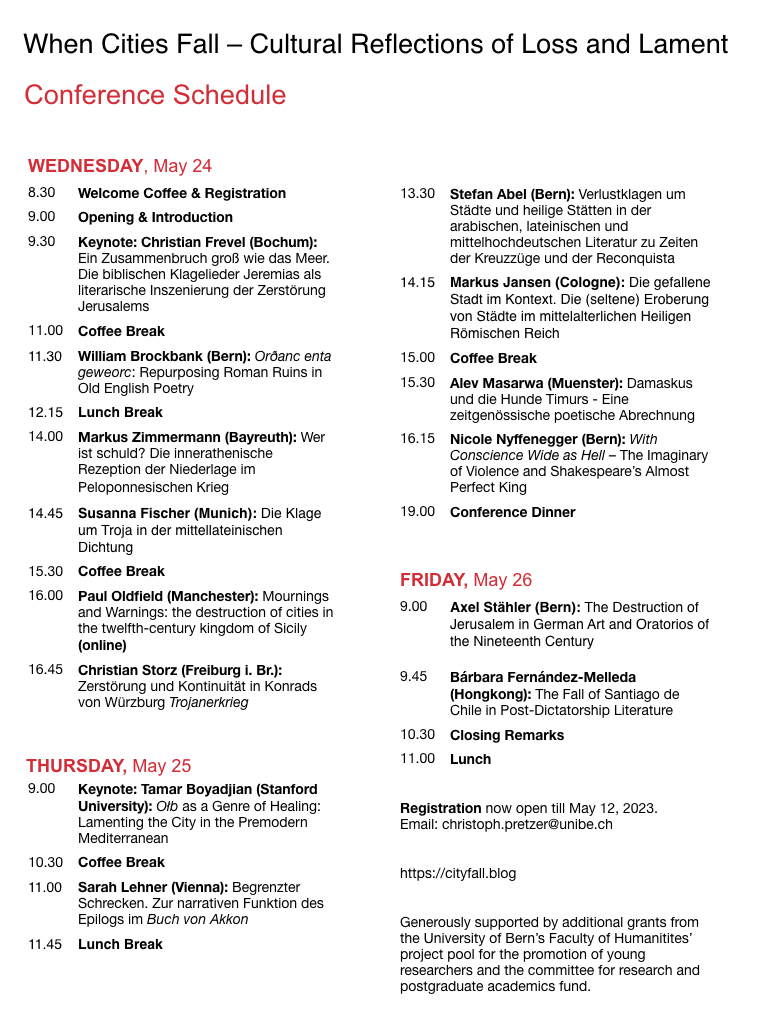
We are inviting submissions of abstracts to take part in the “When Cities Fall – Cultural Reflections of Loss and Lament” conference in Bern, Switzerland from 27th–29th May 2023. “When Cities Fall – Cultural Reflections of Loss and Lament” is organised as part of the EU-funded MSCA-project CITYFALL, based at the Institute for Classical Philology at the University of Bern. At the moment we are very much hoping to have the event in person, but we will have contingency plans for an online/hybrid setup should the need arise.
The fall of a city is not just an incisive event with often catastrophic, long-term, and wide-ranging consequences, but also a moment that captivates the imagination, elicits intense cultural reflections, and is used to draw a dividing line in historical narratives. The global attention given to the defence, conquest, and fall of cities in recent and ongoing conflicts in Syria, Afghanistan, and now Ukraine demonstrates its continuing impact. Yet this is not a modern phenomenon. Since Antiquity the fall of cities has been used to mark historical thresholds, which in some instances originated sprawling mythological, historiographical, and literary traditions (such as those centred on the falls of Troy, Jerusalem or Rome). In pre-modern thinking the framing of the fall of cities in various media plays a crucial role: the stories of their (repeated) falls underpin discourses essential for the negotiation of collective trauma, the attenuation of experiences of loss and disorientation, and the generation of political authority and cultural identity.
The “When Cities Fall” conference seeks to bring together researchers from all backgrounds working on all aspects of city-fall-narratives in general and city laments in particular. There is no restriction in time or space to the sources that are welcome in this context: possibilities range from Sumerian chronicles, to classical epic and drama, to medieval poems, or modern media coverage. Moreover, we would be delighted about proposals working not just with texts but also with visual media such as manuscript illuminations or film.
Proposed papers could examine:
The distinct traditions or individual sources focussed on (city) lament and/or fall-of-city-narratives.
The historiographical uses of the fall of a city as an event, a threshold, or a period marker.
City-fall-narratives as exempla and reference points.
The migration of city-fall-narratives between different cultural or linguistic spheres.
The parallels and differences between pre-modern sources and modern media coverage on the fall of cities.
The anthropological roots, techniques, and purposes of the lamentation of cities.
The relationship between city-fall-narratives, lament, and renewal or rebirth.
The theological/spiritual/moral/ethical problems connected to the loss and destruction of cities and their medial framing and negotiation.
Strategies to aestheticise death, loss, and destruction.
The fall of cities as experiences of collective trauma and its cultural reflections.
The narrative rationalisation of city falls as coping mechanisms.
Conference papers may be presented in English or in German. We are planning the publication of the conference papers in a peer-reviewed open-access volume. There will be keynote lectures by Tamar Boyadjian (Michigan State University) and Ulrich Berges (University of Bonn). Those interested in participating are invited to send an abstract of no more than 300 words to christoph.pretzer@kps.unibe.ch until May 31 2022.
Ok, it’s time to stop beating around the bush and talk about why we are all here. It is time for you to get to know the text that launched it all, the reason why I got interested in Acre to begin with and why in particular in the fall of Acre: Ottokar aus der Gaal’s Buch von Akkon / Book of Acre (BoA).
I came across this peculiar text in mid-2013, when it became increasingly clear that it really was time to stop dicking around and to start working on my MA thesis. I had had a wonderful idea about monsters and heroes in Middle High German and in Persian heroic poetry and manuscript illumination (which I might still revisit someday), but that fell through. That’s when a certain late 13th/early 14th-century gentleman from Styria by the name of Ottokar entered my life and brought with him his monumental 100.000 line long opus known as the Styrian Rhyming Chronicle.
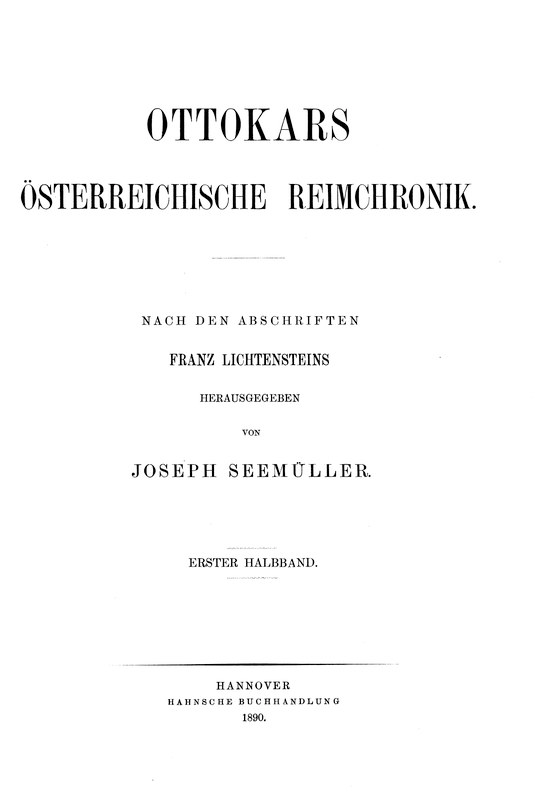
The edition by Josef Seemüller as part of the MGH’s German vernacular series is until today the relevant edition of Ottokar’s monumental chronicle.
I was enthralled.
Within days I read the whole thing: a remarkable account, both rough and fanciful, of (mainly) Austrian and Styrian history from 1246/1250 to 1309/10, when it sadly breaks off, probably due to the – very much not deconstructionist but rather definite – death of the author before 1322. The chronicle has been subdivided into four books by scholarship. Three of those books (I, III and IV) were populated by an unwieldy but entertaining throng of stalwart Styrian nobles, scheming Austrian abbots, noble Bohemian dukes, and greedy Hungarian kings, shrewd Viennese burghers, and bloodthirsty German usurpers. It all made for a lengthy and at times repetitive romp through what certainly was one of the more turbulent periods of the southeastern reaches of the German-speaking lands: the quarrel for supremacy, which followed the end of the ducal Babenberg line in 1246, from which ultimately the „Swabian“ house of Habsburg would emerge victorious.
But what really caught my attention was the second book of the chronicle: with just a little under 10.000 lines it is the shortest of the four books and it basically reads as a big digression, a massive excursus, away from the dynastic troubles, which had engulfed Austria and the neighbouring lands. Instead it provided a detailed and gripping account of the events leading up to and the actual conquest of Acre in 1291. Because of this, Book II of the Styrian Rhyming Chronicle had become known to scholarship as the Book of Acre.
I would end up writing my MA thesis on this second book, mainly on its depiction of the „heathens“, or „Saracens“, terms referring to the literary analogon of real-world Muslims (I published a condensed version of this thesis later in Germanistik in der Schweiz, parts of the article can be accessed here via google books). After this, I moved on to write my PhD thesis on the Kaiserchronik (book has just come out, watch this space!), but the Book of Acre never really let go of me: it was too intriguing a text, too peculiar, too unique in every possible context you might situate it in. And, to my delight and surprise, so very little had been done with it! I always knew I wanted to come back to it one day to do more with it.
Fast forward a short nine years and here we are. It took a couple of years after finishing my PhD in 2017/18 – and many, many rejected research proposals – for the other ingredients of CITYFALL to come to together (Riccoldo’s letters, the Templar of Tyre, lament[ing] as a discourse form etc.), but Ottokar and his Book of Acre was were it all started. So I can say without exaggeration that this is a text very close to my heart and the heart of this project.
For this reason I would like to give this one a bit more space than I have with the others, breaking this „Meet the Texts“ up in three parts: the first (this one) focussing on the author Ottokar aus der Gaal. The second one focussing on the Styrian Rhyming Chronicle and the Book of Acre in its context, with special consideration of the manuscript transmission and the Styrian audience, and finally, the third part, in which I will be contextualising the Book of Acre with the rest of German vernacular writing and other sources on the fall of Acre in 1291.
The Life and Times of Ottokar aus der Gaal
So, time to meet the author: Ottokar aus der Gaal! For me, used to working with 12th-century texts, it was amazing how much we actually know about Ottokar. We have numerous sources providing deep insights into the man’s life in Styria at the turn of the 13th to the 14th century.
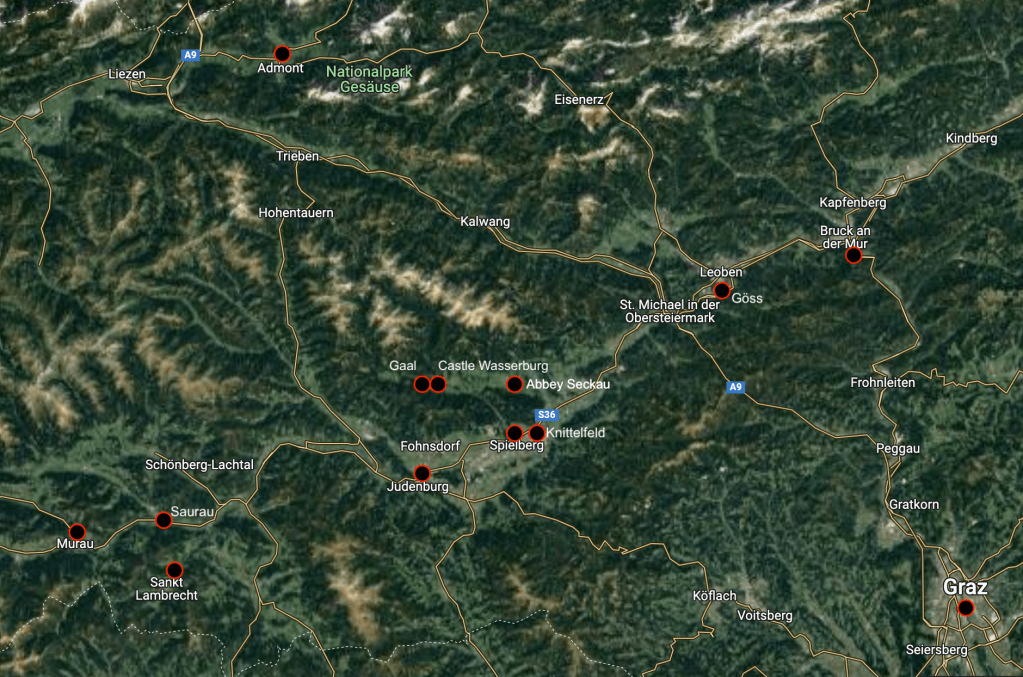
Ottokar was born as the second son of Dietmar and Alheidis aus der Gaal probably around 1265. Dietmar was the lord of Schloss Wasserberg, a castle at the confluence of the rivers Ingering and Gaal in Upper Styria. The aus der Gaal family was a hereditary knightly offshoot of the Strettweg family, which situates them as vassals between the prince-bishop of Seckau, the liege of Schloss Wasserberg, and the Liechtensteiners, a powerful Styrian Ministerialis dynasty, which had itself produced one of the greats of Middle High German literature: Ulrich von Liechtenstein.
No, not that one.
Yes, that one.
Little is known about the early years and – of special interest to us – the education of young Ottokar. But there are several possible scenarios suggested by circumstances, context, and comparison. It is entirely possible that he enjoyed a courtly education at the Liechtensteiner court in Judenburg. The fact that Ulrich lived to the ripe old age of (at least) 75 years (he passed in 1275, but the date of his birth is not quite clear; it must have been 1200 or earlier) has tempted some scholars to speculate about a student-teacher relationship between the ageing author of Middle High German classics like the pseudo-autobiographical Frauendienst (the first German vernacular text written in the 1st person) and the young chronicler. It conjures the romantic image of a 6-to-8-year-old Ottokar sitting starry-eyed at the feet of the grizzled but still sharp knight and poet, while being introduced to Middle High German poetry and song.
It should be added that in none of the charters and deeds, which bear witness to his life, Ottokar is ever addressed as a her or dominus, which would usually indicate a knightly status. This address is reserved for his father and his older brother. While this does not exclude a courtly education, befitting the scion of a hereditary knightly family, it does indicate a non-knightly way of life, maybe more one of a scholar or a clerk. It is likely that his older brother Dietmar was the only one to inherit the knightly title of the family.
Next to or building on these considerations, an ecclesiastical education at e.g. the cathedral school of Seckau also has to be considered. The Augustinian abbey, which did double duty as the cathedral see for the bishopric of Seckau (a suffragan of the archbishop of Salzburg) was in its prime during the later decades of the 13th century and a regional centre of ecclesiastical learning and teaching. In the prologue of his chronicle, Ottokar claims to know Latin and the wide range of sources, he seems to have accessed to compose it, makes it likely that this was more than just an empty boast. However, if he had been educated at an ecclesiastical institution, he later decided against taking the cloth, and lived the life of a layman.
Finally there is an intriguing entry into the matricles of the University of Bologna placing a „d(ominus) Odakar de Stiria“ there in 1291 (!). Some scholars have found knowledge of and interest in legal matters written into Ottokar’s chronicle, which might indicate that the author at some point studied law. Bologna at the time would have been an obvious choice for someone from Styria to do so. And, tantalisingly, being in Bologna would place Ottokar much „closer to the action“ at a critical point in time for the reception of news from the conquest of Acre by the Egyptian Mamluks, i.e. when survivors and thus witnesses of the last days of Acre would arrive in the harbours of Genoa, Pisa and Venice on Italian merchant ships.
However, there is nothing to rule out the possibility that the Odakar matriculated in Bologna in 1291 was simply some random other dude from Styria, who happens to have had the same name as our chronicler.
The places in Upper Styria, where Ottokar was active or which are connected to him by property or by legal obligations
The later part of Ottokar’s life is well-attested. Maja Loehr, Karl Galler, and Bettina Hatheyer have compiled no fewer than forty-six deeds and charters from between 1287 and 1322 in which Ottokar pops up. There is a curious gap of nine years between the earliest charter of 1287 and the next one from 1296. Scholars are very fond of speculating that Ottokar spent this time away from Styria. Intriguingly the entry into the Bolognese univserity matricles falls squarely into his time. He might well have been off to university for some of those years. Another theory, which rests entirely on some vague remarks Ottokar’s narrator makes in the chronicle, is that Ottokar was living the life of a perpatetic singer and performer for a couple of years.
The documents in which Ottokar is named are mostly focussed on legal transactions or obligations concerning properties in or around the locales marked on the map above. Most important among them are Schloss Wasserberg, the home of the aus der Gaal family, Seckau, where their liege the prince-bishop was based, the town of Judenburg, where the Liechtensteiner had their main residence, and the two venerable Benedictine abbies of Admont and St Lamprecht, both of which had feudal connections to Ottokar and his family. Throughout these deeds, Ottokar figures in various roles (often together with his older brother Dietmar), mostly as witness, but also as adjudicator, or as warrantor. In one of the earlier deeds, Ottokar’s possessions are confirmed by Otto II of Liechtenstein, son and successor of Ulrich and at the time camerariusStyriae. Later deeds too suggest a fief-and-vassal relationship between Ottokar and Otto, e.g. in 1309 and 1311 Ottokar and some of his brothers bear witness to donations made by Otto II and in 1312 he is among those corroborating the partition of the Liechtensteiner lands, after the death of Otto II, between his sons Otto and Rudolf.
From the timing of the most recent of the surviving charters, we can conclude that Ottokar must have died some time after October 1319, when he was still sealing a charter in person, and some time before the latest of the charters, dated to January 15 1322, in which Ottokar’s wife Elisabeth is already referred to as a widow.
Next to the testimony of the documentary sources, some scholars have attempted to reconstruct some of Ottokar’s movements from his writings. The suggestion that he might have been a travelling performer for a while comes from this vein. Moreover, the rich and colourful description of the coronation of King Wenceslaus II of Bohemia (who also has some minnelieder transmitted in his name) in 1297 gave rise to the assumption that Ottokar might have attended the festivities there in person. However, the event is also described at great detail in the Königsaal Chronicle, one of Ottokar’s main sources. Later, in the context of the 1304 Habsburg expedition against Wenceslaus, Ottokar’s narrator states that he himself had been in Bohemia at that time. So, if we accept the 1st person voice of the chronicle as speaking for Ottokar, he might have joined his duke Rudolf III of Habsburg, at the time Duke of Austria, and the latter’s father Albrecht I of Habsburg, at the time Roman-German King, for the ill-fated siege of Kutná Horá later that year. The timing and the content of the 1304 charter in which Ottokar’s possessions are confirmed by Otto II of Liechtenstein, for the benefit of Ottokar’s wife and his family, has been interpreted as a possible insurance policy, should anything happen to Ottokar on this endeavour.
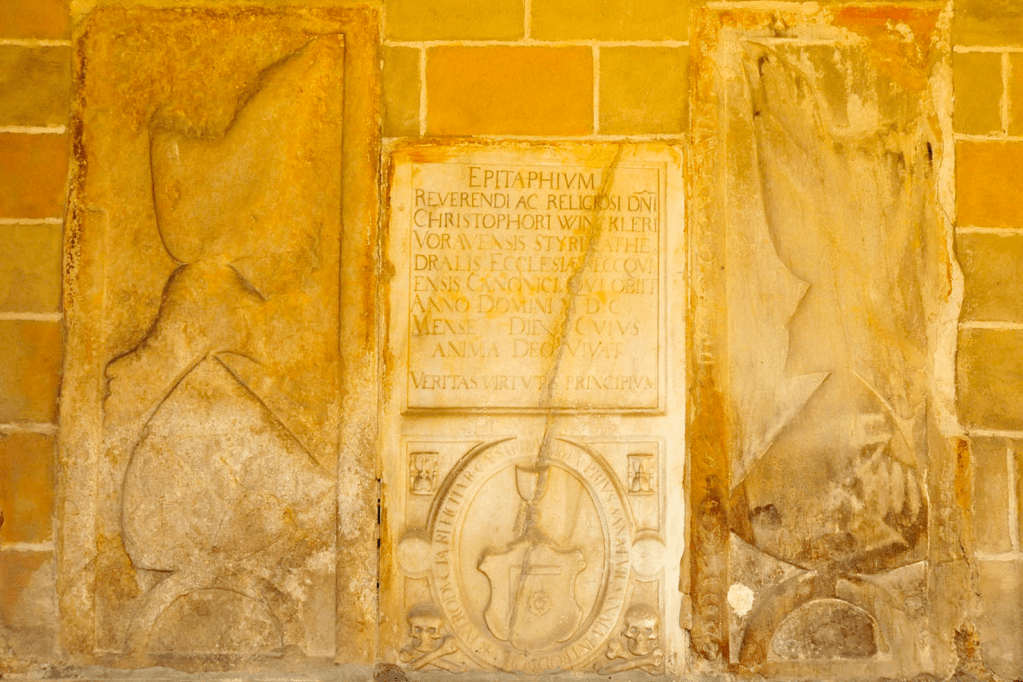
Epitaphs of Ottokar and his wife Elisabeth in the cloisters of Seckau Abbey, Styria, Austria.
Ottokar was buried in the abby of Seckau, where his wife Elisabeth later joined him. Two sandstone epitaphs surviving in the cloisters are associated by local tradition with the couple .
So it came to pass that I was in Baghdad, “among the captives by the river of Chebar” [Ezek 1:1], the Tigris. This garden of delights in which I found myself enthralled me, for it was like a paradise in its abundance of trees, its fertility, its many fruits. This garden was watered by the rivers of Paradise, and the inhabitants built gilt houses all around it. Yet I was saddened by the massacre and capture of the Christian people. I wept over the loss of Acre, seeing the Saracens joyous and prospering, the Christians squalid and consternated: little children, young girls, old people, whimpering, threatened to be led as captives and slaves into the remotest countries of the East, among barbarous nations
Rita George-Tvrtkovic, A Christian Pilgrim in Medieval Iraq, Riccoldo da Montecroce’s Encounter with Islam, Turnhout 2012, Letter V, pp.
The next text – or rather group of texts – I would like to introduce here are the five letters ad ecclesiam triumphantem written by the Dominican missionary and traveller to the East Riccoldo da Montecroce (or sometimes: da Monte di Croce) in an immediate reaction to receiving news of the fall of Acre in 1291.
Born in Florence probably in 1243 his socio-economical background would have predestined Riccoldo to join the Franciscans: he was a son of the reasonably well-off Pennini family, from the urban craftsmen-shopkeeper class and grew up in the San Pier Maggiore neighbourhood, dominated by the massive Sta Croce monastery of the Franciscans. Riccoldo at one point even mentions his lifelong devotion to St. Francis of Assisi, but in 1267 he joined the Dominicans of Sta Maria Novella. He remained an active member of the ordo praedicatorum for the rest of his life: fifty-three years and five months, as the necrology of Sta Maria Novella notes after his death in 1320. During this time Riccoldo rose to the office of subprior and prior of his house, became a prolific writer with several important works tied to his name, and – most importantly for our purposes – travelled widely: He went on pilgrimage in the Holy Land, hitting all the main loca sancta in Galilee and Judea, including the Church of the Holy Sepulchre in Jerusalem. After this he went north on a missionary journey through Antolia and Armenia into Persia and finally Bagdad.
Sta Maria Novella in Florence with the famous Renaissance façade added by Alberti 1456–1470.
He went on pilgrimage in 1288 (disembarking in Acre!) and arrived in Bagdad in 1291 at the latest. It was here that he heard about the fall of Acre. It is not quite clear how long he stayed in Bagdad or the East in general. The Sta Maria Novella necrology notes plurimo tempore – for a long time – and the first reliable source placing him back in his native Florence dates to March 1301. So all in all he might have been in the East up to twelve years, ten of which mostly based in Bagdad. He devoted is time to learning Arabic and studying Islam: its theology, liturgy and religious customs. He visited mosques and joined Muslims in their private homes, aided by an enviable command of Arabic.
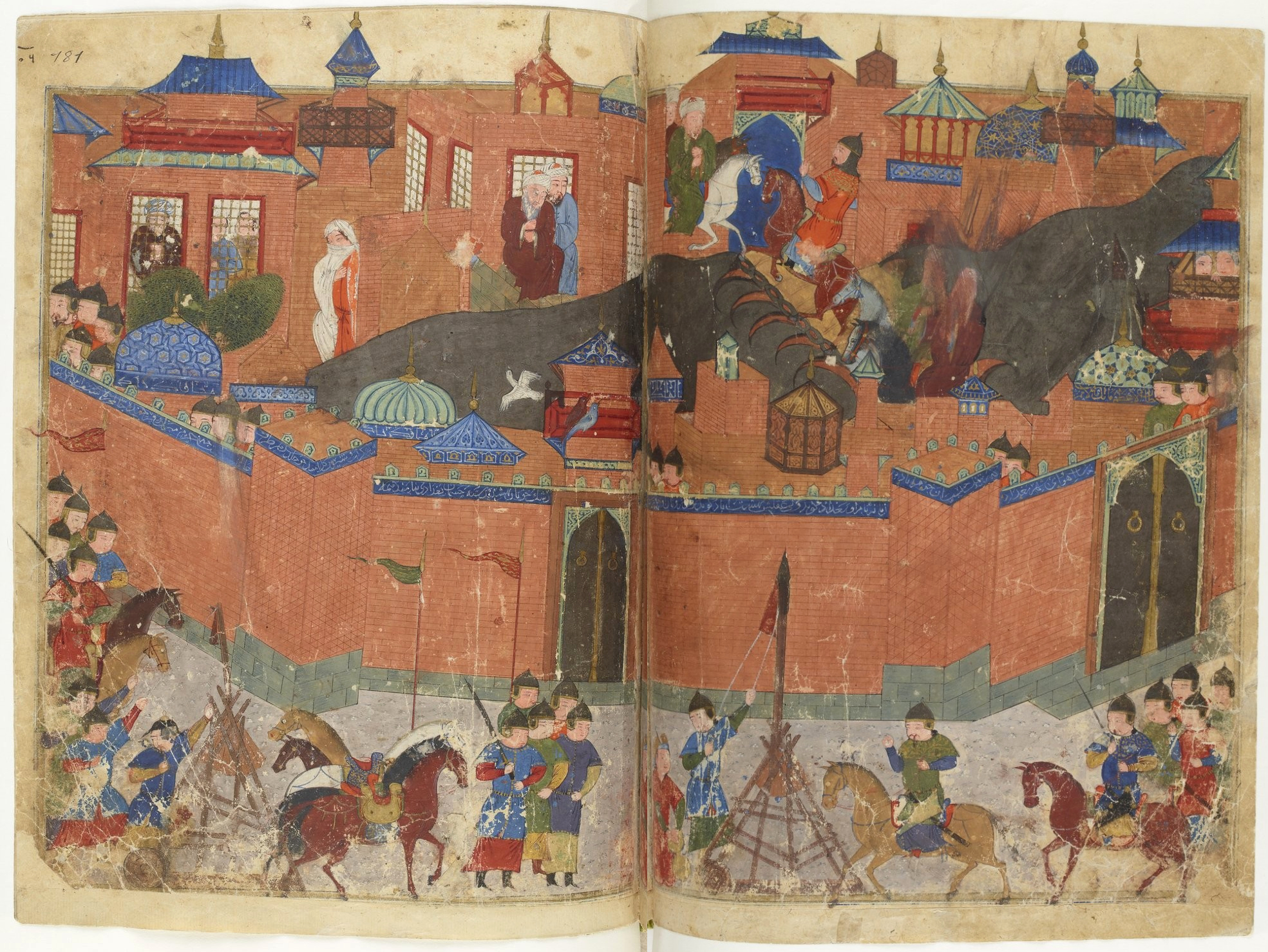
He also commented on the conversion to Islam of the ruling Mongol dynasty the Ilkhanids. Led by Hulagu Khan, grandson of Genghis Khan, the Mongols had conquered Bagdad in 1258, some thirty years before Riccoldo’s arrival in the city, thus effectively ending the Abbasid caliphate. During his time in the city the Ilkhanids slowly but surely turned from an elite class of conquerors into a Muslim ruling dynasty. Probably due to the Mongols fully embracing Islam under Maḥmūd Ghāzān in 1295 Riccoldo had to lie low for a while, working as a camel driver on the caravan trails of Persia and Arabia.
Riccoldo’s writings are extraordinarily versatile. The best known and most-discussed is probably his Contra legem Sarracenorum, an anti-Islamic polemic, also known as Confutatio Alcorani. It proved tremendously influential across Christian Europe, well into the 16th century, when it was translated into German as the Verlegung des Alcoran by a certain Martin Luther. Riccoldo’s next big work is the Ad nationes orientales, a missionary manual which displays deep insights into the differences between Christians, Jews, Muslims, but also Mongols and Oriental Christians. It also offers practical tips on how to best convert them to Christianity. Moreover, his Liber peregrinationes gives a detailled account of his pilgrimage in the Holy Land and his following journey into Persia towards Bagdad. In all likelihood all of these texts were written after his time in the East, safely back home in his monastery in Florence.
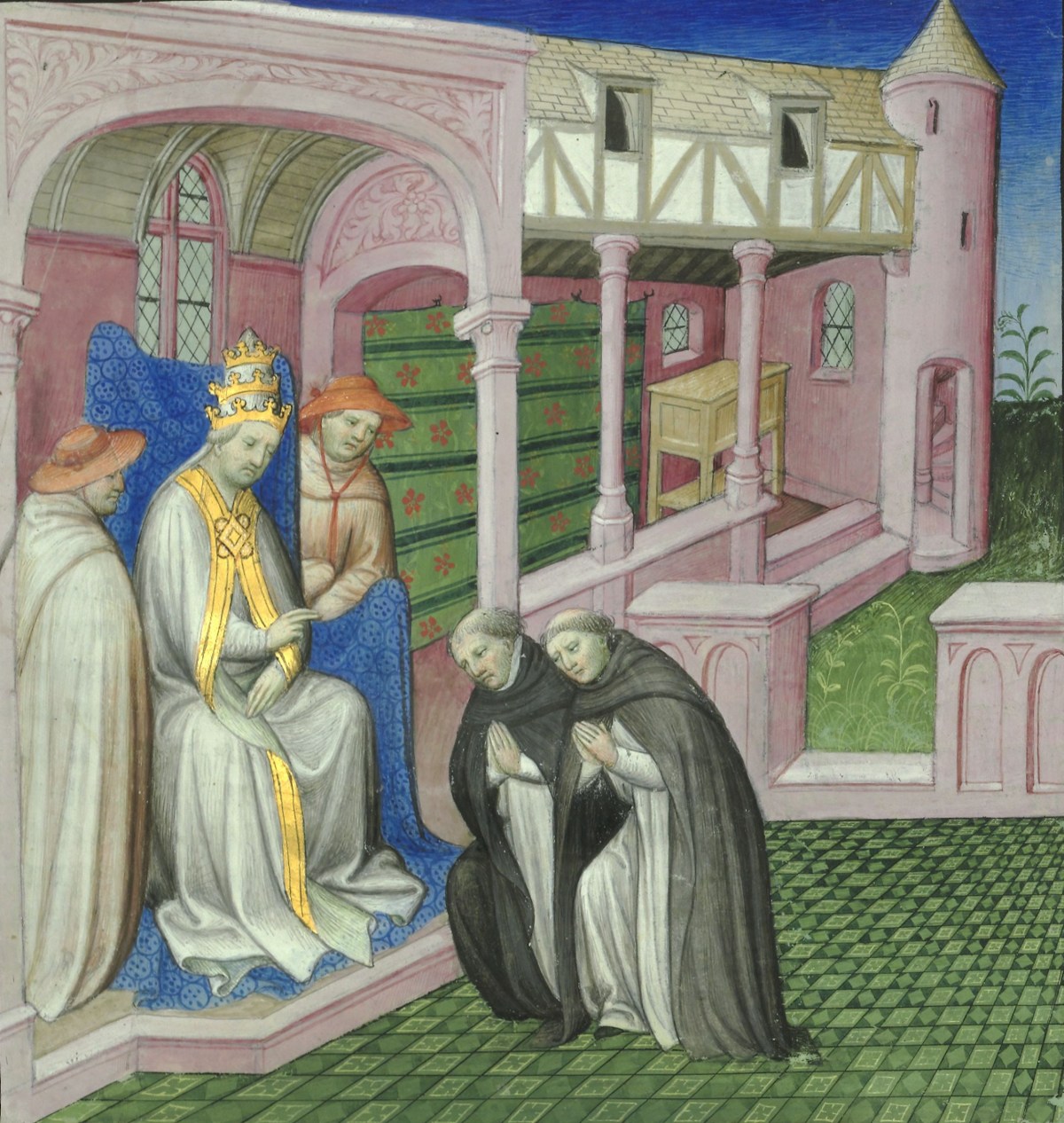
Riccoldo and Pope Nicolas IV., Ms. Français 2810, Bibliothèque nationale de France, f. 268r
His Epistolae ad ecclesiam triumphanten however, were data in oriente, so probably drafted while still in the East and then finalised when back in Italy. The letters survive in only one badly-preserved manuscript in the Vatican library: Vat. lat. 7317 a remarkable collection of texts compiled for pope Eugenius IV in the 15th century. Here the Epistolae can be found in august – and highly topical – company: Albert of Aix’s early 12th-century Historia Hierosolymitanae expeditionis, one of the most important sources on the First Crusade, in particular on the so-called „people’s crusade“, opens the codex. It is followed by Raimundus Lullus‚ 1305 Liber de fine, which develops a plan for a two-pronged campaign against the Muslims: on the one hand one of informed preaching and on the other hand one of military pressure. After this comes the Historia Orientalis, an important chronicle of the crusader states by no other than Jacques de Vitry, who, in the early 13th-century, was bishop of Acre. In this function he also wrote several equally scornful and entertaining letters home to France, in which he presented a very colourful image of the vices, crimes, and general moral depravity of the inhabitants of Acre.
After this come two of Riccoldo’s texts, the Epistolae and one version of the(in)famousConfutatio Alcorani.
Riccoldo’s texts are then followed by Il Milione, an early Tuscan version of the travels of Marco Polo, circulating widely throughout the 14th century. After a papal bull by Eugenius IV comes the De varietate fortunae, a tractate illustrating the changing fortunes of history, exemplified through the ruins of ancient Rome written in 1447 by the humanist Poggio Bracciolini. Finally the manuscript concludes with the Iter Hierosolymitanum of Ludolf von Sudheim, another ecclesiastical traveller to the East some fifty years after Riccoldo (and the fall of Acre).
The manuscript constitutes a remarkable collection, showing great papal engagement with the crusades, both as a historical topic and an ongoing movement, well into the 15th century.
Riccoldo’s five letters were edited in 1881 in the Archives de l’Orient latin by Reinhold Röhricht one of the founding figures of modern crusade studies. More recently Rita George-Tvrtković produced a very insightful dissertation on Riccoldo’s theology of Islam, which also includes an English translation of both the Liber peregrinationis and the Epistolae. Very much a recommended read:
George-Tvrtkovic, Rita: A Christian Pilgrim in Medieval Iraq. Riccoldo da Montecroce’s Encounter with Islam (Medieval Voyaging 1), Turnhout 2012.
The Epistolae offer an immediate and raw reaction to the news of the conquest of Acre. We will take a closer look at the structure and content of the letters in the next post here, where we will find Riccoldo lamenting the fall of Acre „by the rivers of Babylon“.
Sadly not much I am doing at the moment is very apt to put it on the blog: I have two articles under construction with upcoming deadlines, so most of my time and energy goes there.
Accurate depiction of me trying to bring order to the chaos of my draft articles
I did manage to update the post on the Templar of Tyre with a short section on the manuscript and its edition history if you want to risk another look (just after the halloumi picture).
When I get stuck with my articles, I do some reading on the role and status of French in Outremer or on Acre as a cultural centre. Here is some recommended reading I have really enjoyed on these topics:
The French of Outremer, ed. by Laura Morreale and Nicholas Paul (Fordham Series in Medieval Studies), Fordham University Press: New York 2018.
This volume brings together several interesting contributions to the topic. I found the introduction (pp. 1-13) by Morreale and Paul and the first article by Laura Minervini „What we know and don’t yet know about Outremer French“ (pp. 15-29) particularly helpful.
Fordham University also has a project focussed on the French of Outremer. On their website you can find some very instructive short essays, which make for an excellent introduction, but also long lists of all the sources written in French in the Holy Land.
Cyril Aslanov, „Crusaders’ Old French“ in Research on Old French: The State of the Art (Studies in Natural Language and Linguistic Theory 88), Springer: Heidelberg/New York 2013, pp. 207-220.
A linguistic deep dive into the formation and the morphology of „Outremer French“. Rich with examples and utterly fascinating, but sometimes so dense it becomes difficult to follow, in particular if you have to look up Old French words all. the. time.
Le français dans tous les sens, Henriette Walter, 1988, p. 149
Some key take-aways from my reading:
Old French, Francine, the Romance vernacular spoken in the Île-de-France and Paris at the time, became the lingua franca of the Latin Crusader states. We knew that but now I can state it with greater confidence!
The French spoken in Outremer through a process of koineisation emerged basically as another Langue d’oïl koiné parallel to Francine in Europe. Linguistically it seems to have been most closely related to the French spoken in the Northeast of the French language continuum: Picard, Walloon, Lotharingian, and perhaps Burgundian. This is not surprising since this is where the leaders of the First Crusade mainly came from and from where many nobles emigrated to the Holy Land, once the crusader states had been established.
In the Levant French came into close contact with other Romance vernaculars like Occitan (in Tripolis, which was dominated by langue d’Oc-speaking conquerors from what is now southern France), Norman (in Antioch, which was dominated by Norman conquerors from Southern Italy), and the various Italo-Romance dialects (in the coastal cities and later on Cyprus, mainly from Venice, Genoa, and Pisa). This led to a process of re-romanisation of the French spoken in the Holy Land, while French-French was surrounded mostly by Western Germanic languages and, as Aslanov puts it, „deeply [g]ermanized“.
There where several, usually one-sided, transfer processes of lexical material between French and the languages it came into contact with in the East. While Greek and Armenian took on French terms, French proved impervious to them. The other way round, French, that is Outremer French of course, did take on several Arabic terms, while Arabic did not adopt any French terms (with some prominent exceptions usually tied to the specific contexts of the crusades, like the Frankish words famously used by the Syrian knight and diplomat Usama ibn Munqidh in his Kitab al-I’tibar [كتاب الاعتبار, The Book of Learning by Example])
Outremer French was used in the Kingdom of Jerusalem and later of Cyprus for purposes that would have been reserved for Latin in Europe: legal texts, treatises, and charters, coins, seals, and inscriptions. In particular when dealing with non-Latin-speakers, the crusaders often resorted to French as the language of diplomacy and „international relations“.
The use of French in the Levant was highly innovative and productive. John of Antioch (NOT that one) wrote one of the earliest reflections on French grammar in French and the scriptorium in Acre produced breathtaking manuscripts of French texts like the famous Histoire ancienne jusqu’à César.
A possible reason for the great success of the French vernacular in the Levant might have been the contact with the Greek and Arabic-speaking world, where the functional diglossia of the Latin West did not exist.
Currently I am reading this:
Jonathan Rubin, Learning in a Crusader City, Intellectual Activity and Intercultural Exchanges in Acre, 1191–1291 (Cambridge Studies in Medieval Life and Thought), CUP: Cambridge 2018.
I am only halfway through this intriguing exploration of Acre as a centre of intellectual activity in the 13th century, but so far it is a very immersive and sometimes eye-opening read.
Before I wrap this up, let me share with you my discovery of the month: there is a Hebrew lament about the fall of Acre in 1291!
In it, a certain Yosef ben Tanhum Yerushalmi, a Jewish poet living in Mamluk Cairo (!), combines the lament for a personal loss, the death of his father, the highly-regarded scholar Tanhum ben Yosef Yerushalmi, with the lament for a political catastrophe, the destruction of Acre. Yosef starts his dirge by temporally and causally connecting the passing of his father and „the arrival of the news about the massacre of all the scholars living in Acre, together with their entire families, upon the conquest of the city by the Muslims“.
Some context: during the 13th century an influential, well-connected, and prosperous Jewish community had developed in Acre. It was particularly highly-regarded for the learnedness of its scholars. This community was destroyed when the Mamluks captured Acre. This destruction is also corroborated by Rabbi Isaac of Acre who escaped to Spain and later recalled the burning of the synagogue in Acre.
Yosef’s poem is rich with biblical imagery and deeply embedded in the Hebrew elegiac tradition, which of course is founded on the Book of Lamentations (אֵיכָה, Êykhôh in Hebrew and as part of the Ketuvim part of the Hebrew Bible). As such the text is heavily shaped by conventional motifs and poetic elements. It does not really offer an account of the events or even of what exactly happened to the Jews of Acre, but the language of lamentation shines brilliantly.
Woe! For blood was shed in God’s house, and their blood is easily worth gold of Parvayim.
It was a very bitter tragedy in the eyes of everyone who heard of it, like the day of the destruction of Jerusalem.
A noble community was killed because of their love for God, while they were stretching out their hands to Him in supplication.
Judeo-Arabic Heading and Hebrew Poem (on the Basis of Manuscript EVR II, A 100/1, fol. 16a–b, National Library of Russia), ll. 18-20
The parallelisation with the fall of Jerusalem and the effect, which the news of this event has, as it spreads, is of course striking. References to the destruction of Jerusalem are often many-layered. Shades of the Neo-Babylonian capture under Nebuchadnezzar II in the early 6th century BCE mingle with the catastrophic sack of the city by the Romans in 70 CE and of course the bloody conquest by the crusaders in 1099 as the culmination of the First Crusade. In the tradition of the Hebrew elegy, the destruction of Jerusalem and of the Temple is the ultimate political catastrophe and the worthiest cause for lamentation. In Yosef’s elegy this context is evoked to elevate the memory of his father and to emphasise his status as a man of wisdom and knowledge.
That the Jews of Acre were killed „because of their love for God“ and during prayer, turns the dead of Acre into martyr-scholars and posits the poem in the long tradition of Jewish martyrdom tales. The martyrdom of the Jewish scholars is elevated by the connection to the destruction of Jerusalem and in turn their martyrdom elevates the status of the place in which they were killed, since their blood is as valuable as the gold of Parvayim, the finest gold imaginable used by King Solomon to decorate his temple in Jerusalem [2. Chron 3:6]. The relationship between the falls of Jerusalem and Acre is mutually enforcing and elevating as causes for lamentation of the highest poetical order.
I am not sure why, but it is tremendously exciting to find this beautiful and deeply moving lament for (not only but also) Acre in a non-Latin/Christian/Western/European context.
All of this has been made available to the grateful non-Hebrew speaking/reading reader in this article:
Joachim J. M. S. Yeshaya, „A Hebrew Elegy by Yosef ben Tanhum Yerushalmi on the Death of his Father and the Mamluk Conquest of Acre“, in Frankfurter Judaistische Beiträge 39 (2014), pp. 33-52.








 Cityfall